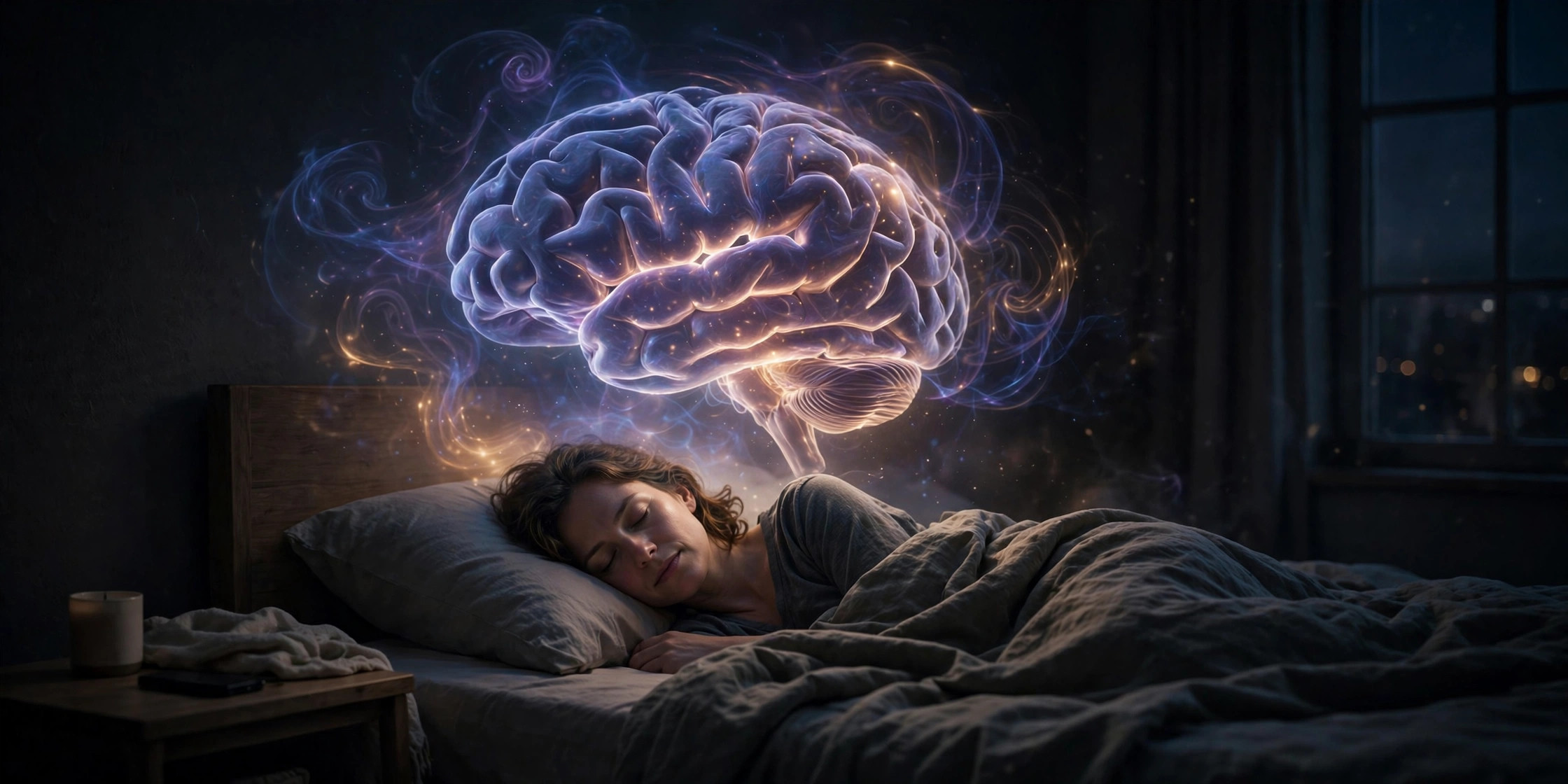
What Is REM Sleep? Why Your Brain Needs It
Every night, your brain holds a therapy session you never remember attending. It replays the day’s events at up to twenty times their original speed, files away what matters, and — most remarkably — takes your hardest memories and quietly removes their sting. All of this happens during one specific stage of sleep, while your body lies temporarily paralyzed beneath vivid dreams.
That stage is REM sleep, and it may be the most underrated quarter of your night. Most people know it as “the dreaming stage” and leave it at that. But the science of what REM sleep actually does — memory consolidation, emotional processing, creative problem-solving — explains why cutting your night short by even 90 minutes can leave you foggy, fragile, and flat the next day.
In this guide, I’ll answer “what is REM sleep” properly: what your brain is doing during it, when it happens across your night, the overnight-therapy mechanism researchers have uncovered, what suppresses it (some common culprits will surprise you), and how to get more of it. By the end, you’ll understand why the final 90 minutes of your night matter more than almost any other part of your sleep.
So what is REM sleep, exactly? In simple terms, it’s the paradoxical stage of sleep when your vividly dreaming brain is nearly awake while your body lies still — and understanding what is REM sleep explains why the last 90 minutes of your night matter most.
What REM Sleep Actually Is: The Paradox Stage
REM stands for rapid eye movement — named for the eyes darting beneath closed lids. But the stranger truth is the paradox: during REM, your brain activity climbs to near-waking levels while your body goes profoundly still. Sleep scientists call it paradoxical sleep, and it’s unlike anything else your brain does.
Here’s what’s happening in your body during a REM episode:
- Brain: highly active — EEG readings resemble wakefulness, with fast, desynchronized waves.
- Eyes: moving rapidly in all directions (the defining feature).
- Muscles: temporarily paralyzed (atonia) — every major muscle group goes limp, which keeps you from acting out your dreams.
- Breathing and heart rate: fast and irregular, climbing toward waking levels.
- Dreams: the most vivid, narrative, emotionally charged dreams of the night happen here.
That muscle paralysis deserves a moment. It’s a protective feature, not a malfunction: without atonia, you’d physically punch, kick, and run through every dream. (In a rare condition called REM behavior disorder, this paralysis fails and people do exactly that — if you or a partner regularly act out dreams, that’s worth discussing with a sleep doctor.)
For context on where REM fits in the bigger picture, our guide to the four stages of sleep maps the full nightly architecture. Here, we’re going deep on the one stage where your brain does its most fascinating work.
The bottom line: REM is the paradox stage — a nearly-awake brain in a paralyzed body. That strange combination is exactly what makes its work possible.
When REM Happens: Why the Final 90 Minutes Matter Most
REM doesn’t spread evenly through your night — it’s deliberately back-loaded. The first REM episode arrives about 90 minutes after you fall asleep and lasts only around 10 minutes. But each cycle stretches it further: by the early morning, REM episodes can run 30 minutes to a full hour.
This creates a lopsided night: deep sleep dominates the first half, REM dominates the second. And that has a brutal implication most people miss. Cut your night short by 90 minutes — say, a 5:30 alarm instead of 7:00 — and you haven’t lost a proportional slice of everything. You’ve amputated the single longest REM episode of the night, the one where the most memory consolidation and emotional processing was scheduled to happen.
Think of it as a concert where the headliner plays last. Leaving early doesn’t cost you 20% of the show — it costs you the entire finale. If you want the full breakdown of how stages shift hour by hour, here’s how a single 90-minute sleep cycle unfolds — and our free sleep calculator can time your alarm to land at a cycle boundary instead of mid-REM.
The bottom line: REM concentrates in the last third of your night. Guard the end of your sleep and you guard your REM.
Your Brain’s Overnight Therapy Session
Here’s the most remarkable thing REM sleep does — and the reason sleep scientists call it overnight therapy.
During REM, one of the most active regions of your brain is the amygdala, your emotional processing center — in some measurements, more active than when you’re awake. But it operates in a radically different chemical environment: levels of norepinephrine, the stress hormone that makes difficult experiences feel threatening, drop to near zero.
Neuroscientist Matthew Walker’s lab at UC Berkeley pieced together what this combination means. During REM, your brain replays emotionally significant experiences from the day — but in a neurochemical environment stripped of the stress chemistry that made them feel overwhelming. The result: you wake up with the memory intact but its emotional charge reduced. The event is filed; the sting is defused.
This is why disrupted REM is so consistently linked to anxiety, emotional volatility, and PTSD symptom severity. When the nightly defragmentation can’t complete, yesterday’s emotions bleed into today at full volume. People with PTSD, notably, show fragmented REM — the therapy session keeps getting interrupted.
So when someone says “sleep on it, you’ll feel better in the morning” — that’s not folk wisdom. That’s REM sleep doing neurochemistry.
The bottom line: REM lets your brain reprocess hard experiences without the stress hormones — you keep the lesson, lose the sting.

How REM Files Your Memories (at 20x Speed)
The second great job of REM is memory consolidation — and the mechanics are wilder than most people imagine.
During sleep, your brain replays the day’s experiences: hippocampal neurons fire in patterns mirroring what they recorded while you were awake. Research published in Nature Reviews Neuroscience showed this replay happening during both slow-wave and REM sleep — and in animal studies, researchers watched individual neurons replay maze routes at up to 20 times faster than real time. Your brain is speed-running your day, deciding what to keep, what to connect, and what to discard.
REM is especially important for two kinds of memory:
- Procedural memory — skills and habits: the piano piece, the tennis serve, the new shortcut at work. Practice plus REM is why you wake up better at something than when you went to bed.
- Emotional memory — experiences with feeling attached, filed alongside the overnight-therapy process above.
And there’s a bonus job: creativity. During REM, the brain forges connections between distant ideas — the associative, non-linear logic you experience as dreams is the feeling of that cross-referencing happening. It’s no coincidence that Paul McCartney composed the melody for “Yesterday” in a dream, or that chemist Dmitri Mendeleev credited a dream with revealing the structure of the periodic table. REM is your brain’s nightly brainstorming session, held without your permission and usually without your memory of attending.
The bottom line: REM speed-files your memories and cross-links your ideas — it’s where learning consolidates and creativity brews.
REM Rebound: Your Brain Collects Its Debts
Here’s proof of how badly your brain wants its REM: deprive it, and it comes back swinging.
REM rebound is the brain’s overcompensation after REM suppression. When something — alcohol, certain medications, sleep deprivation, untreated sleep apnea — steals your REM for a night or more, the brain responds by plunging into longer, denser, more vivid REM episodes the moment it gets the chance. People experiencing rebound often report intensely vivid, sometimes disturbing dreams. That’s not a disorder; it’s the debt being repaid.
This is well documented in sleep labs: patients starting CPAP treatment for sleep apnea frequently show REM rebound in their first nights of treated sleep. The same pattern follows alcohol withdrawal and the discontinuation of REM-suppressing medications. The brain keeps a ledger, and it always collects.
Which raises the obvious question: what’s been suppressing your REM in the first place?
The REM Suppressors Hiding in Your Routine
Several common substances and conditions quietly tax your REM every night. Knowing them is half the battle:
| Suppressor | What it does to REM | What to do |
|---|---|---|
| Alcohol | Suppresses REM in the first half of the night, then triggers fragmented REM rebound 4–5 hours after sleep onset. Even two drinks within three hours of bed measurably reduces REM proportion in polysomnography studies. | Keep a 3+ hour gap between your last drink and bed; less is better. |
| Cannabis (THC) | High doses reduce REM; a 2020 study found heavy users had significantly lower REM percentages than non-users. Stopping can trigger vivid-dream rebound. | Be aware of the trade-off if sleep quality matters to you. |
| Some antidepressants (esp. SSRIs) | Potent REM inhibitors — drugs like paroxetine and citalopram can nearly eliminate REM; stopping can cause strong rebound. | Never stop or change prescribed medication without your doctor. If sleep is suffering, discuss alternatives with them. |
| Stimulants & late caffeine | Delay sleep onset and fragment architecture, compressing the late-night REM window. | Cut caffeine by early afternoon. |
| Chronic stress | Fragments sleep and disrupts the long late-night REM stretches — ironic, since REM is what would process the stress. | Wind-down routine; address the daytime source, not just the night. |
| Sleep apnea | Repeated breathing interruptions fracture sleep into fragments too short for sustained REM. | Loud snoring + daytime sleepiness = get evaluated. CPAP often restores REM dramatically. |
One critical note on medications: if you take an antidepressant or any prescribed drug that affects sleep, do not stop or adjust it because of this article. The REM effect is real, but your prescription exists for a reason — any change belongs in a conversation with your doctor, who can weigh the trade-offs with you.
The bottom line: alcohol is the most common REM thief, but medications, cannabis, stress, and apnea all take their cut. Audit your evenings honestly.
How to Get More REM Sleep
You can’t force your brain into REM on command — but you can build the conditions that let it happen generously:
Why does getting more REM sleep matter so much? Because REM sleep is when your brain consolidates the day’s learning and defuses difficult emotions — skimp on REM sleep and you blunt both. The good news: better REM sleep mostly comes down to protecting the final 90 minutes of your night, which is exactly what the habits below do.
- Protect the last 90 minutes. This is the highest-leverage move on the list. A consistent wake time — even on weekends — lets your brain schedule its longest REM confidently in the pre-dawn hours.
- Keep alcohol 3+ hours from bed. The single most common REM suppressor is also the most fixable.
- Get enough total sleep. REM is back-loaded, so 7–9 hours (per CDC guidance) is the price of admission — a 6-hour night doesn’t just trim REM, it deletes the richest portion.
- Wind down the stress. A real wind-down routine — dim lights, no work email, something calming — reduces the fragmentation that shreds late-night REM.
- Keep it cool, dark, and quiet. The standard sleep-environment trio protects all stages, REM included.
- Treat suspected apnea. If you snore loudly or wake unrefreshed despite long nights, get evaluated — restoring REM is one of the most immediate benefits of treatment.
The bottom line: consistent wake time plus a full-length night plus an honest alcohol audit covers ~90% of REM optimization.

When to Talk to a Doctor About REM
Most REM issues are habit-driven and fixable. But a few patterns deserve professional attention:
- You act out your dreams — punching, kicking, shouting, or getting out of bed during vivid dreams (possible REM behavior disorder).
- Loud snoring with gasping or pauses, plus daytime sleepiness despite long nights (possible sleep apnea).
- Sudden muscle weakness with strong emotions like laughter (possible narcolepsy sign, alongside excessive daytime sleepiness).
- Persistent vivid nightmares that disrupt your life, especially after trauma.
The American Academy of Sleep Medicine maintains directories of accredited sleep centers. And the National Sleep Foundation is a solid starting point for understanding what’s normal and what isn’t. This article is educational — for personal concerns, a clinician beats a blog post every time.
Sources
- Centers for Disease Control and Prevention — Sleep information
- National Sleep Foundation
- American Academy of Sleep Medicine
The Takeaway
So, what is REM sleep? It’s your brain’s overnight shift: a paradoxical stage — vivid mind, paralyzed body — where memories get consolidated at high speed, emotions get defused without their stress chemistry, and creativity gets its nightly brainstorm. It takes up a fifth to a quarter of your night, hides mostly in the final hours before dawn, and quietly underwrites your memory, mood, and mental sharpness.
Protect it like it matters — because it does. Keep a consistent wake time, give yourself a full night, keep alcohol well clear of bed, and let your alarm land at a cycle boundary. Our free sleep calculator does the timing math for you, so you wake up when a cycle ends — not in the middle of your brain’s most important work.
The next time you’re tempted to trim your night short, remember what is REM sleep: your brain’s overnight therapy, memory consolidation system, and creative workshop. Protecting your REM sleep is one of the simplest investments you can make in a sharper, steadier mind.
What Is REM Sleep? Frequently Asked Questions
What is REM sleep in simple terms?
REM (rapid eye movement) sleep is the dreaming stage of sleep, when your brain becomes highly active while your body is temporarily paralyzed. It makes up 20–25% of adult sleep, concentrates in the second half of the night, and handles memory consolidation and emotional processing.
How much REM sleep do I need per night?
Most adults need roughly 90–120 minutes of REM per night — about 20–25% of total sleep. In an 8-hour night that’s around 96–120 minutes. There’s no official per-night prescription, but consistent trouble concentrating, low mood, or vivid-dream rebound after short nights suggest you’re running a REM deficit.
Why do I dream more in the early morning?
Because REM episodes get longer as the night goes on. The first REM period lasts about 10 minutes; by early morning they can run 30–60 minutes. Longer REM means longer, more vivid dreams — and waking during one is why you remember them.
Does alcohol really kill REM sleep?
It suppresses it significantly. Alcohol reduces REM in the first half of the night and fragments it later — even two drinks within three hours of bed measurably lowers REM proportion in sleep-lab studies. You may sleep seven hours and still wake up REM-deprived.
What is REM rebound?
REM rebound is your brain’s overcompensation after REM deprivation — longer, denser, more vivid REM episodes (and intense dreams) once the suppressor is gone. It’s common after stopping alcohol, starting apnea treatment, or discontinuing REM-suppressing medications. It’s a sign the brain is repaying a debt, not a disorder.
Can you get too much REM sleep?
Excessive REM percentage on a sleep study usually signals rebound after deprivation, medication withdrawal, or conditions like depression or narcolepsy — not that healthy REM itself is harmful. If a sleep study shows unusually high REM, discuss the context with your doctor rather than trying to reduce it.