Waking Up at 3 AM Every Night? Causes & How to Fix It
It’s 3:04 AM. Your eyes snap open in a dark room, your mind is already racing, and you know — with sinking certainty — that you’ll be staring at the ceiling for the next hour. Sound familiar? You’re far from alone: National Health Interview Survey data show that roughly 1 in 5 adults have trouble staying asleep most days or every day.
Here’s what most articles won’t tell you: 3 AM isn’t random. It’s the exact hour when your lightest sleep, your rising stress hormone, and your personal weak spot collide. Waking up at 3am every night has a biological explanation — and once you know which trigger is yours, the fix is usually simpler than you’d think.
The catch? Most people try to fix the wrong thing. They blame stress when it’s actually their wine with dinner, or fight insomnia when the real culprit is an undiagnosed breathing problem. By the end of this guide, you’ll know exactly how to identify your trigger, what to do at 3 AM tonight, and how to end the pattern for good.
Why 3 AM Specifically? Your Body’s Vulnerability Window
If you’re waking up at 3am every night, the first thing to understand is that the time matters less than the math behind it. For most people, 3 AM falls roughly 4–5 hours after sleep onset — and that’s the most fragile stretch of the night.
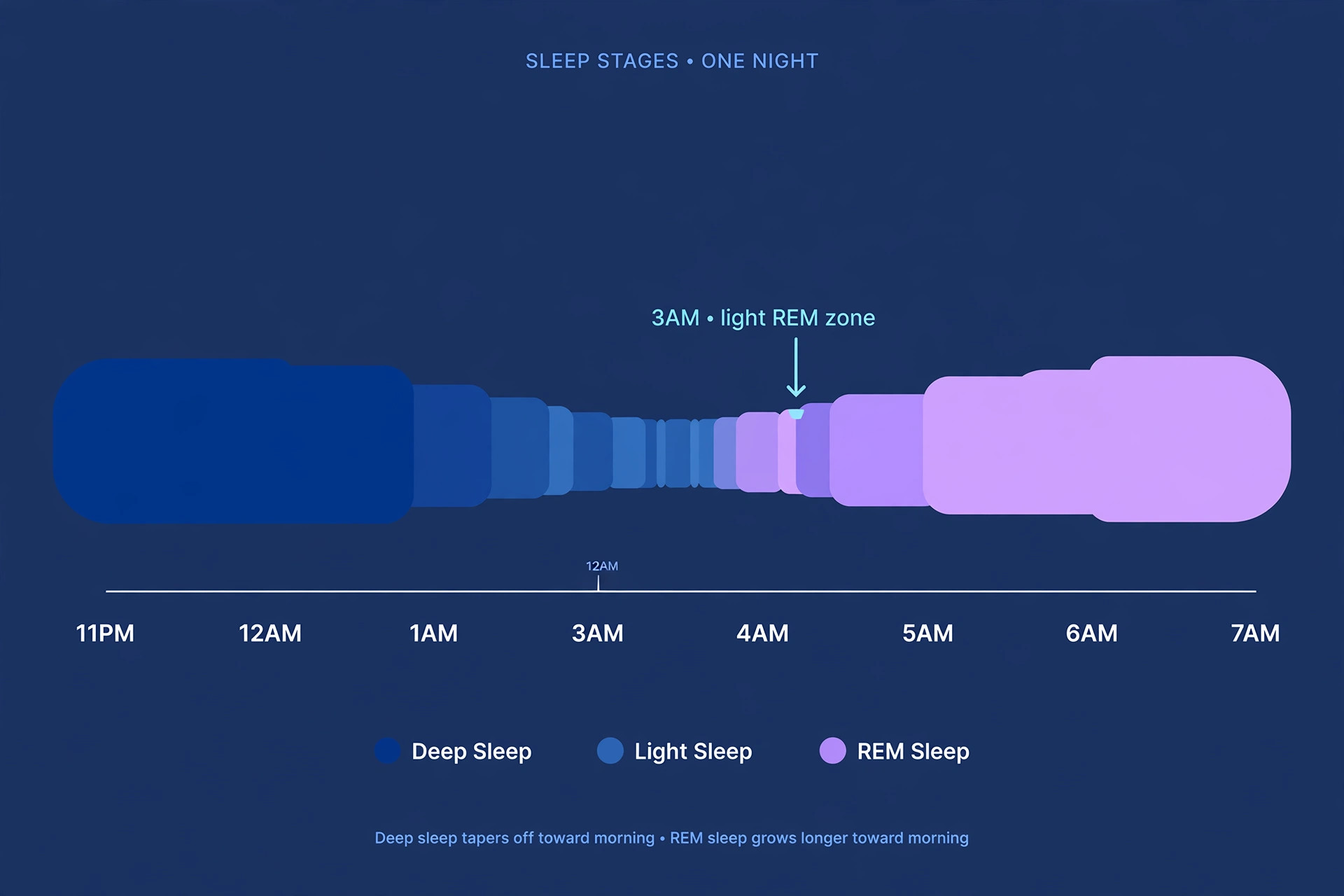
Sleep isn’t one continuous state. You cycle through roughly 90-minute sleep cycles, and each cycle changes character as the night progresses:
| Time of night | Dominant sleep stage | Stress hormone (cortisol) | How easy is it to wake? |
|---|---|---|---|
| 10 PM – 12 AM | Deep slow-wave sleep (N3) | Very low (near nightly minimum) | Very hard |
| 12 AM – 2 AM | Mixed deep and light sleep | Beginning to rise | Moderate |
| 2 AM – 4 AM | Light, REM-heavy sleep | Actively rising | Very easy |
| 4 AM – 6 AM | Light REM, near-wake | High, climbing toward morning peak | Easy |
Deep sleep dominates the first third of your night. By 2–4 AM, deep sleep is largely done for the night and REM sleep takes over — longer, more vivid dreaming, and a brain much closer to wakefulness. You also cross sleep-cycle boundaries in this window, and every boundary is a brief micro-arousal where the brain “checks in.” In a perfect night you don’t notice. Add any one trigger, and that micro-arousal becomes a full wake-up.
The bottom line: 3 AM is when your sleep is at its lightest and your body’s wake-up machinery is already warming up. Any extra push — stress, alcohol, a full bladder, a breathing pause — tips you over. Your personal wake time just reflects your bedtime: go to bed at midnight instead of 10 PM, and your “3 AM” becomes 5 AM.
A quick honesty check: sleep researchers also note that people tend to remember the 3 AM wake-ups and forget the 2:14 and 4:40 ones. You probably aren’t waking at exactly 3:00 every night — but the cluster around the middle of the night is very real.
The Cortisol Question: What the Evidence Actually Says
Search “waking up at 3am every night” and half the internet blames cortisol, your body’s main stress and alertness hormone. The story goes: cortisol bottoms out around midnight, starts climbing around 2–3 AM, and peaks in the morning — so a premature surge jolts you awake.
There’s real truth in this. Cortisol follows a daily rhythm, and researchers at the University of Bristol showed in 2025 that cortisol rises in the hours before waking as the body prepares for the day — it’s not just a reaction to the alarm. When you’re chronically stressed, the whole curve can shift earlier and steeper, turning a gentle pre-dawn ramp into a 3 AM jolt. The HPA axis — the brain-adrenal system that governs cortisol — is disrupted in a large share of people with chronic insomnia.
But here’s the nuance the cortisol-blame articles skip. Sleep physician Dr. Funke Afolabi-Brown has noted that cortisol spikes are often wrongly blamed, and that there’s little evidence lowering morning cortisol fixes these sleep issues. Independent sleep expert Dr. Neil Stanley points out that cortisol mainly rises in the ~90 minutes before your habitual wake time — which undermines the idea that a 3 AM surge alone explains everything.
So which is it? The most evidence-consistent view, echoed by clinical sleep institutes, is that cortisol is often responding to another underlying issue rather than being the primary problem — a blood-sugar dip, a breathing pause, anxiety, a hot flash. The cortisol surge is the alarm bell, not the fire.
The bottom line: Yes, your stress hormone is rising at 3 AM, and yes, chronic stress makes the rise harsher. But if you want to stop waking up, hunt for what triggers the surge — that’s what the next section is for.
9 Reasons You’re Waking Up at 3am Every Night (and How to Fix Each)
Every trigger below produces a slightly different wake-up. Read for the pattern that matches you — there’s a self-diagnosis table after this section.
1. Chronic stress and an overactive stress response
The pattern: You wake with your mind already running — tomorrow’s meeting, the bills, that conversation. Your heart rate is up before you’re even fully conscious.
This is the single most common driver. Daytime stress keeps your sympathetic nervous system (“fight or flight”) dialed up into the night, and the 2–4 AM window — when your body begins shifting toward morning alertness — is where the accumulated tension finally breaks through. A 2025 AASM survey found more than 75% of US adults report at least occasional difficulty falling or staying asleep, and stress is the leading self-reported cause.
Fix it: The fix isn’t “less stress” — it’s a wind-down boundary. Stop work and news 60–90 minutes before bed, dim the lights, and do a 5-minute “brain dump” on paper: everything on your mind, out of your head. It sounds trivial; it works because the racing mind at 3 AM is usually unfinished business your brain refuses to drop.
2. Your bedtime doesn’t match your sleep cycles
The pattern: You fall asleep fine but surface like clockwork in the middle of the night, night after night.
If you consistently go to bed at the same time, you’ll consistently wake at the same cycle boundary. Seven to eight hours of sleep equals about 5 full sleep cycles per night — and a bedtime that strands you at a boundary around 3 AM means your lightest sleep lands exactly in the vulnerability window. The 90-minute rule is a simplification (real cycles run 70–110 minutes), but the principle holds: when you sleep shapes when you’re easy to wake.
Fix it: Shift your bedtime by 20–30 minutes in either direction for a week and watch whether the wake-up moves. Use our free sleep calculator or the bedtime calculator guide to pick bedtimes that complete full cycles.
3. Alcohol’s 3 AM rebound
The pattern: You fall asleep easily after evening drinks, then wake wide-eyed 3–5 hours later — often hot, sometimes with your heart pounding.
Alcohol is a sedative, not a sleep aid. It suppresses REM sleep early in the night, then as it metabolizes (roughly one drink per hour), the suppression lifts and you get a “rebound” — fragmented, vivid-dream sleep plus a sympathetic surge. This is one of the most predictable 3 AM triggers in existence.
Fix it: Keep drinking to earlier in the evening and stop at least 3–4 hours before bed. If you wake at 3 AM after drinking, notice the pattern for a week — for many people, this single change ends the nightly wake-ups.
4. Caffeine past its curfew
The pattern: You can fall asleep, but your sleep feels shallow and you surface repeatedly in the early hours.
Caffeine’s half-life is about 5–6 hours, meaning a 4 PM coffee is still half-active at 10 PM. It blocks adenosine — the chemical that builds sleep pressure — so your brain never fully powers down. The result isn’t always trouble falling asleep; often it’s trouble staying asleep.
Fix it: Set a hard caffeine cutoff 8–10 hours before bed. And don’t forget hidden sources: tea, chocolate, pre-workout, and some pain relievers.
5. Nocturia — needing to pee
The pattern: You wake needing the bathroom, every single night, at roughly the same time.
Here’s the twist researchers highlight: you usually wake for another reason, then notice your bladder. True nocturia — waking because of the urge — is common (a US population study estimated about 31% of adults have two or more nightly bathroom trips), and it climbs with age, but in many 3 AM wakers the bladder is the messenger, not the cause. Still, evening fluid timing matters.
Fix it: Front-load fluids earlier in the day, cut back 2–3 hours before bed, and skip alcohol and caffeine in the evening (both increase urine output). If you’re up twice or more nightly and it’s new or worsening, talk to your doctor — it can signal prostate, blood-sugar, or blood-pressure issues.
6. Sleep apnea — the silent interrupter
The pattern: Your partner notices snoring, pauses, or gasping. You wake with a dry mouth, morning headaches, or crushing daytime fatigue despite “enough” hours.
Obstructive sleep apnea causes brief breathing pauses — the brain micro-arouses to restart breathing, dozens or hundreds of times a night. You may not remember these arousals; you just experience “waking up at 3 AM for no reason” plus unrefreshing sleep. The AASM estimates at least 4% of men and 2% of women have OSA with daytime sleepiness, and 80–90% of cases remain undiagnosed.
Fix it: This one isn’t DIY. If anyone has seen you stop breathing, gasp, or choke in your sleep — or if you’re exhausted despite full nights — ask your doctor about a sleep study. Treating apnea often ends the 3 AM wake-ups entirely, and the health stakes (blood pressure, heart disease, stroke risk) are real.
7. Overnight blood-sugar dips
The pattern: You wake shaky, sweaty, or hungry, sometimes with a racing heart — and then the anxious thoughts start.
Here’s a reframe worth hearing: the anxiety may be the result, not the cause. If blood sugar dips overnight, the body releases cortisol and adrenaline to bring it back up — and adrenaline feels exactly like anxiety. Your brain then helpfully invents worries to match the feeling. This “double whammy” — the cortisol morning-rise colliding with a glucose crash — lands squarely in the 2–4 AM window.
Fix it: Avoid going to bed on an empty stomach after a very early dinner, but don’t eat a heavy late meal either. A small protein-rich snack (yogurt, nuts) an hour before bed helps some people. If you have diabetes or frequent shaky wake-ups, talk to your doctor — this one deserves professional input, not guesswork.
8. Perimenopause and hormonal shifts
The pattern: You’re in your 40s–50s, waking drenched or overheated, often with mood changes and daytime fatigue.
Fluctuating estrogen and progesterone fragment sleep directly, and hot flashes are a documented middle-of-the-night trigger — moderate-to-severe hot flashes make frequent night waking roughly 3 times more likely. Women are more likely than men to report trouble staying asleep, and the gap widens in midlife.
Fix it: Cool the room (around 18°C / 65°F), use breathable bedding, and keep water by the bed. If night sweats or mood symptoms are disrupting your life, a menopause-informed clinician can help — there are effective options, and you don’t have to white-knuckle it.
9. A racing mind (what keeps you awake ≠ what wakes you)
The pattern: Something small wakes you — a noise, a dream, the bladder — and then your brain takes over and won’t let go.
Sleep experts draw a crucial distinction: what wakes you is not the same as what keeps you awake. Brief awakenings at cycle boundaries are normal and happen to everyone; noticing them and spiraling is what turns a 30-second arousal into a 90-minute ordeal. At 3 AM, with no distractions, half-formed worries feel enormous — researchers call this a state effect, not insight. Nothing feels as bad at noon as it does at 3 AM, and that’s biology, not truth.
Fix it: The in-the-moment protocol below is built for exactly this. Long-term, cognitive-behavioral techniques (scheduled “worry time” during the day, getting out of bed when stuck) are the gold standard — worth exploring if this is your main pattern.
The bottom line: Almost everyone waking up at 3am every night has one primary trigger plus the universal vulnerability window. Find your trigger in the diagnostic below, fix that first, and the window stops mattering.
Find YOUR Trigger: The 3 AM Diagnostic
If you’re waking up at 3am every night, this table is the fastest route to your answer. Match your wake-up pattern to the most likely cause. Track for one week before concluding anything — patterns beat single nights.
| What your 3 AM wake-up feels like | Most likely trigger | Try this first |
|---|---|---|
| Mind already racing, heart up, dread about tomorrow | Stress / overactive stress response | Evening brain dump + 60-min wind-down |
| Wide awake but calm, like clockwork, same time nightly | Sleep-cycle timing mismatch | Shift bedtime 20–30 min; use a sleep calculator |
| Hot, heart pounding, 3–5 hours after evening drinks | Alcohol rebound | No alcohol within 3–4 hours of bed |
| Shallow sleep all night, surface repeatedly | Late caffeine | Hard caffeine cutoff 8–10 hours before bed |
| Must pee — but you were already half-awake | Nocturia (possibly secondary) | Fluid curfew 2–3 hours before bed; note what woke you first |
| Partner reports snoring, gasping, or pauses; dry mouth mornings | Sleep apnea | See your doctor about a sleep study |
| Shaky, sweaty, or hungry with a racing heart | Blood-sugar dip | Small protein snack before bed; talk to your doctor |
| Drenched, overheated, in your 40s–50s | Perimenopause / hormones | Cool room, breathable bedding; see a clinician |
| Woke from a noise or dream, then couldn’t switch off | Racing mind / conditioned arousal | The 3 AM protocol below; stimulus control |
What to Do at 3 AM Tonight: The In-the-Moment Protocol
You’re awake. Here’s the exact sequence sleep clinicians recommend:
- Don’t check the time. Seeing “3:07 AM” starts the math (“only 3 hours left!”), which spikes alertness. Turn the clock face away — permanently.
- Stay in bed for ~20 minutes, relaxed. Keep the lights off, lie still, and breathe slowly: in for 4 counts, out for 6. The long exhale activates your parasympathetic nervous system. Don’t “try” to sleep — just rest.
- If you’re still wide awake after ~20 minutes, get up. Go to another dim room and do something boring: read a dull book, fold laundry. This is stimulus control — it breaks the bed = awake association. Return only when sleepy.
- Write down the thought. If a worry is looping, scribble it on paper by dim light. Your brain clings to unfinished business; externalizing it tells your nervous system the job is handled.
- No phone, no bright light, no “quick checks.” Screens deliver alerting content and light that suppresses melatonin — the exact opposite of what you need at 3 AM.
- Don’t watch the clock on your return either. You’ll drift off faster when your brain isn’t auditing the process.
The bottom line: The goal at 3 AM isn’t to force sleep — it’s to stay calm and boring. Sleep follows calm; it flees from effort.

The 14-Day Fix Plan: Ending the Pattern
One-off tricks don’t fix a nightly pattern. This plan targets the system. Expect morning-light and schedule changes to show effects within about a week; habit changes typically need 2–3 weeks. For anyone waking up at 3am every night, the schedule is usually the highest-leverage fix of all.
Days 1–3: Anchor the schedule. Pick a fixed wake time and keep it — including weekends. Get bright light (sunlight ideally) within 30 minutes of waking. This single habit resets your circadian rhythm more powerfully than any supplement, because it pins your cortisol curve to the right hours.
Days 4–7: Cut the chemical triggers. Enforce the caffeine cutoff (8–10 hours before bed) and the alcohol curfew (none within 3–4 hours of bed). Move fluids earlier in the day. Notice which nights you sleep through — the pattern will name your trigger.
Days 8–14: Optimize the environment and the wind-down. Bedroom around 18°C (65°F), dark, quiet. Screens off 60 minutes before bed; a short wind-down routine (shower, book, brain dump) at the same time nightly. If you wake, use the 3 AM protocol above instead of fighting it.
The most overlooked piece: a consistent bedtime matters as much as a consistent wake time. Plan a consistent bedtime with our free sleep calculator — pick your wake time and let the cycle math choose bedtimes that land you in deep sleep early and carry you through the fragile 3 AM window.
How to Get Through Tomorrow (After a Bad Night)
Nobody talks about this, but you still have a day to live. Here’s the damage-control playbook:
- Keep your normal wake time. Sleeping in shifts your rhythm later and makes tomorrow night worse.
- One short nap max — 20 minutes, before 2 PM. Longer or later naps steal tonight’s sleep pressure. (Our nap-length guide explains the 20 vs 90-minute rule.)
- Front-load caffeine, then stop. One or two morning coffees are fine; nothing after noon on a bad-sleep day.
- Get outside. Morning light plus a walk does more for alertness than a third espresso.
- Go to bed at your normal time tonight — not two hours early. An early bedtime just moves the 3 AM window earlier.
What Your Sleep Tracker Can Tell You
If you wear an Apple Watch, Fitbit, Oura ring, or similar, your 3 AM wake-ups leave fingerprints:
- Heart-rate spikes at wake time with no movement beforehand point toward stress/arousal triggers (cortisol, anxiety, blood-sugar adrenaline).
- Snoring detection or restless, fragmented sleep with low deep-sleep totals points toward possible apnea — worth a doctor’s visit.
- Wake-ups that follow room-temperature spikes (some trackers log this) point to overheating or hormonal flashes.
Trackers can’t diagnose anything — they measure movement and heart rate, not brain waves — but two weeks of data turns “I always wake up” into “I wake at 3:10 on nights I drink wine.” That specificity is gold.
When to See a Doctor
Most 3 AM waking is a habit-and-trigger problem, not a disease. But book an appointment if:
- Anyone has seen you stop breathing, gasp, or choke in your sleep
- You’re exhausted during the day despite spending enough hours in bed
- The pattern has lasted more than 3 months despite fixing the triggers above
- You have loud, nightly snoring with morning headaches or dry mouth
- Night waking comes with chest pain, new frequent urination, or significant mood changes
This article is educational, not medical advice — a clinician can sort out whether your pattern is behavioral, hormonal, or medical, often faster than months of self-experimentation.
The Bottom Line
Waking up at 3am every night feels mysterious, but it’s mechanics: the lightest sleep of the night meets your rising alertness hormones, and one personal trigger tips you over. Find your trigger in the diagnostic table, run the 14-day fix plan, and use the 3 AM protocol on the nights it still happens.
The single highest-leverage change? A consistent sleep schedule built on real cycle math. Use our free sleep calculator to find your ideal bedtime — set the wake time, get the bedtimes, and give your brain the deep, unbroken first half of the night it needs to sail through 3 AM asleep.
By Mark David
Sources
- American Academy of Sleep Medicine — Sleep Prioritization Survey: Insomnia Awareness Night 2026 (2,007 US adults; 75%+ report difficulty falling or staying asleep)
- Chung et al. — Estimation of the global prevalence and burden of insomnia (systematic review; global insomnia prevalence 16.2%)
- American Academy of Sleep Medicine — Obstructive Sleep Apnea fact sheet (prevalence; 80–90% undiagnosed)
- Yokoyama et al. — Prevalence of nocturia and nocturnal polyuria (population-based prevalence data)
- CDC — About Sleep and Your Heart Health (adults need at least 7 hours of sleep nightly)
- Midi Health — Waking Up at 3 a.m.? Why It Happens (cortisol rhythm: lowest ~midnight, rising from ~2–3 AM; hot flashes and night waking)
Frequently Asked Questions
Is it normal to wake up at 3 AM every night?
Brief awakenings during the night are normal — everyone surfaces at sleep-cycle boundaries. What’s not ideal is being unable to fall back asleep night after night. If it happens most nights for weeks, it’s worth identifying your trigger using the diagnostic above rather than accepting it.
Why do I wake up at 3 AM and can’t go back to sleep?
Usually it’s a two-part problem: something wakes you (a cycle boundary, alcohol rebound, a full bladder, a breathing pause) and then something keeps you awake (racing thoughts, clock-checking anxiety, bright light from your phone). Fix the trigger and the in-the-moment response separately.
Does waking up at 3 AM mean something is spiritually wrong with me?
No — despite the folklore, there’s no physiological evidence for a special meaning. The consistency of the timing comes from sleep architecture and hormone rhythms, not messages. If the folklore comforts you, enjoy it; but the fix is biological, in the sections above.
Should I eat something when I wake up at 3 AM?
A small protein-rich snack before bed can help if you wake shaky or hungry, suggesting a blood-sugar dip. But don’t make 3 AM snacking a nightly habit — regular middle-of-the-night eating can train your body to expect food then. Prevent the dip at bedtime instead.
How do I stop waking up at 3 AM for good?
Identify your trigger with the diagnostic table, apply its specific fix, anchor a consistent wake time with morning light, and enforce caffeine and alcohol curfews. Most people see improvement within 1–3 weeks. If nothing changes after a month of consistent fixes, see a doctor.
When should I see a doctor about waking up at night?
See a doctor if you snore loudly, gasp, or stop breathing in your sleep; if you’re very sleepy during the day despite enough time in bed; if the pattern persists beyond 3 months; or if night waking comes with chest pain, mood changes, or new urinary symptoms.