Night Shift Sleep Schedule: How to Rest Like a Pro
You know the exact moment. It’s 7:12 a.m., your shift just ended, and the parking lot is blinding. You squint your way home, collapse into bed, and somehow — despite being bone-tired — you’re wide awake at noon with three more hours of “sleep” to go. The best sleep schedule for night shift workers isn’t about willpower or “just getting used to it.” It’s about working with your circadian rhythm instead of fighting it.
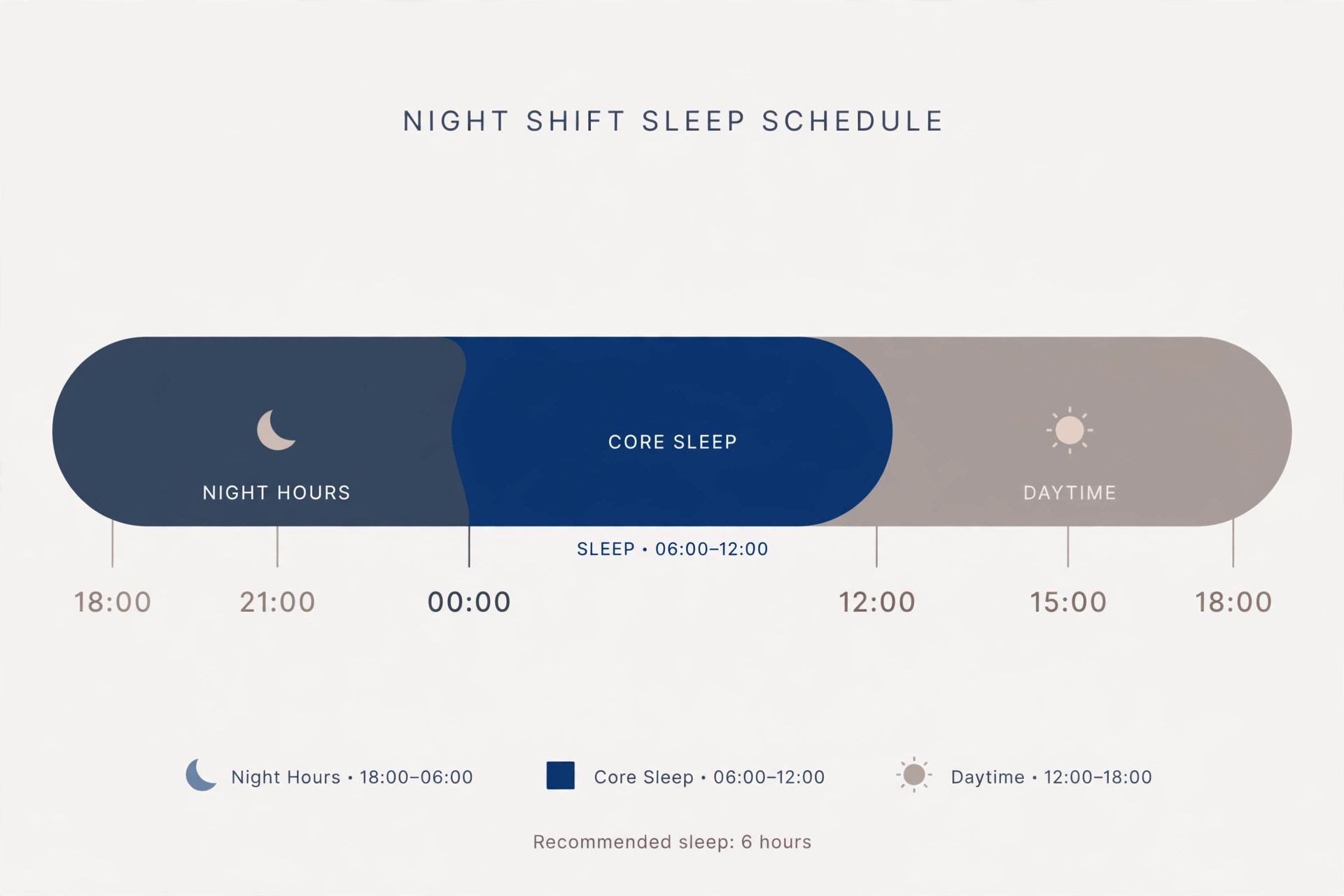
Here’s the core answer up front: the most evidence-backed plan is anchor sleep. For a typical 11 p.m.–7 a.m. shift, that means sleeping roughly 8:00 a.m. to 3:30 p.m. after work (about 7.5 hours, five full 90-minute sleep cycles), then protecting at least a 4–5 hour overlap of that window on your days off — say 9 a.m. to 1 p.m. One NIOSH analysis of 6,338 U.S. workers found night-shift workers had a 61.8% prevalence of short sleep versus 35.9% among day workers, so protecting that window isn’t a luxury — it’s the whole game.
By the end of this guide, you’ll know exactly which sleep pattern fits your shift, how to time light and caffeine like a remote control for your body clock, what to do on the first and last nights of a rotation, and how to spot the difference between normal night-shift fatigue and something that needs a clinician. Let’s build your schedule.
The Best Sleep Schedule for Night Shift Workers: The Anchor-Sleep Framework
Every serious guide to this topic — from the CDC’s nurse training modules to sleep-lab research — converges on the same principle: consistency beats perfection. Your circadian rhythm is a roughly 24-hour internal clock driven by light, and light is the strongest zeitgeber (time-giver) your brain listens to. You can’t fully flip that clock to nocturnal life and keep it there — daylight on your days off keeps yanking it back. What you can do is give it one unmovable anchor.
Anchor sleep means keeping at least 4–5 hours of your sleep window at the same clock time every single day, workday or day off. If your post-shift sleep runs 8:00 a.m. to 3:30 p.m., you protect 9:00 a.m. to 1:00 p.m. even when you’re off. That overlap is the repeatable signal your body clock latches onto. A 2023 Cochrane review on shift-schedule adaptation found that schedule design variables — shift permanency, protected sleep time, and split-sleep options — were the core levers tied to sleep quality, duration, and sleepiness across 11 studies and 2,125 participants. In plain English: the design of your schedule matters more than any supplement or hack.
The bottom line: pick one sleep pattern you can repeat for months, not one that’s theoretically perfect. Anchor sleep is the safest default for permanent nights because it gives your circadian system one fixed reference point instead of asking it to relearn your schedule every weekend.
Your 11 PM–7 AM Sample Timetable (Hour by Hour)
Most night-shift guides stay vague here. You came for a schedule, so here’s one — built around the most common U.S. night shift, 11 p.m. to 7 a.m. Adjust the clock by your actual hours, but keep the structure: protected post-shift sleep, bright-light alertness at work, a real wind-down, and meal times that repeat daily.
| Time | What to do | Why it works |
|---|---|---|
| 10:00 p.m. | Wake up, hydrate, light exposure (bright lamp or daylight if available) | Light tells your circadian clock your “morning” has started |
| 10:30 p.m. | “Breakfast”: protein-rich meal (eggs, yogurt, lean meat) | Consistent meal timing is a secondary zeitgeber that reinforces the schedule |
| 11:00 p.m. | Shift begins — keep the workspace bright | Bright light in the first half of the shift suppresses melatonin and sustains alertness |
| 2:00 a.m. | Caffeine cutoff | Caffeine’s half-life is 5–6 hours; later doses push your 8 a.m. bedtime further away |
| 3:30 a.m. | “Dinner”: your main mid-shift meal, balanced and not heavy | Regular fueling prevents the 4 a.m. energy crash without overloading digestion |
| 5:00–6:30 a.m. | Dim the lights if you can; wind down mentally | Lowering light in the last stretch signals the coming sleep window |
| 7:00 a.m. | Shift ends — sunglasses ON before you step outside | Morning sunlight is the single strongest “stay awake” signal; block it before it hits your eyes |
| 7:30 a.m. | Light snack, warm shower, phone on Do Not Disturb | The post-shower body-temperature drop nudges sleepiness; DND protects the window |
| 8:00 a.m. | Bed — blackout room, white noise, cool air | Your anchor block begins: 8:00 a.m. to 3:30 p.m. (7.5 hours = 5 sleep cycles) |
| 3:30 p.m. | Wake up — open blinds, get daylight immediately | Daylight now anchors the wake side of your shifted rhythm |
| 4:00–6:00 p.m. | Exercise, errands, daylight exposure | Movement + light in your “afternoon” builds healthy sleep pressure for the next block |
| 8:30 p.m. | “Lunch”: light, low-sugar meal before work | Avoids the pre-shift sugar crash that mimics fatigue |
| 9:30 p.m. | Optional 20-minute pre-shift nap | Banked alertness before the longest wake stretch of your day |
The bottom line: your day is a day-worker’s day flipped and shifted — meals, light, exercise, and sleep all land at consistent clock times. That repetition is doing more for your sleep quality than any gadget.
Should You Sleep Right After Your Shift, or Split It in Two?
This is the biggest fork in the road, and the honest answer is: sleep right after your shift if you can protect one uninterrupted block; use split sleep when life makes that impossible.
A 2022 sleep-lab study put this to a real test: 12 men working two consecutive 12-hour night shifts tried three between-shift patterns — immediate sleep (7 a.m.–2 p.m.), delayed sleep (10 a.m.–5 p.m.), and split sleep (7 a.m.–10:30 a.m. plus 1:30 p.m.–5 p.m.). Total sleep time didn’t differ significantly, but the split-sleep condition had less wake-after-sleep-onset and more deep slow-wave (N3) sleep than the other two. That doesn’t crown split sleep the universal winner — it proves it’s a legitimate strategy, not a failure mode.
| Anchor (one block) | Split sleep (two blocks) | |
|---|---|---|
| Pattern | One 7–8 hour block right after the shift (e.g., 8 a.m.–3:30 p.m.) | Main block after shift (e.g., 8 a.m.–1 p.m.) + 90-min nap before the next shift (e.g., 5:30–7 p.m.) |
| Best for | Permanent night workers with a quiet, dark home | Long commutes, childcare, back-to-back 12s, noisy homes |
| Circadian signal | Strongest — one fixed daily window | Good if the main block stays fixed; the nap floats |
| Sleep quality | Excellent when uninterrupted | Can yield more deep sleep (per the lab study above) |
| Social life | Disappears from daytime entirely | Afternoon free for family, errands, appointments |
| Days off | Keep the 4–5 hour anchor identical | Keep the main block identical; drop the nap |
| Risk | Falls apart if the block gets interrupted | Temptation to shrink the main block and “nap it off” |
If you go split, size your blocks in 90-minute multiples so you wake between sleep cycles rather than from deep sleep — waking mid-cycle is what produces that groggy, disoriented sleep inertia that can linger for 30 minutes or more. Never let the main block drop below about 4–5 hours; the nap is a supplement, not the foundation.
The bottom line: one protected block is the gold standard, but split sleep is a research-validated Plan B — not a compromise to feel guilty about.
The First-Night and Last-Night Transition Protocol
Almost nobody covers this, yet these two nights wreck more schedules than anything else. Your body pays an adaptation cost every time you swing between day and night mode — so make those swings deliberate.
Before your first night shift in a block
Do not stay up all day and “power through.” The CDC’s NIOSH training for night workers explicitly warns against this: you’ll be awake for 20+ hours straight, your accident and injury risk spikes, and you start the block already in sleep debt. Instead:
- Sleep in on the morning of your first night — wake around 10–11 a.m. if you can.
- Take a 2–3 hour nap in the late afternoon (roughly 4–7 p.m.), the strategy CDC/NIOSH recommends before a first night.
- Get bright light early in the shift and keep your caffeine to the first half of the night.
- Accept that night one is the hardest. Adenosine (your brain’s sleep-pressure chemical) has been building all day; the nap trims it, but the first shift of a block is physiologically the roughest. Plan easier tasks for the first two hours if your job allows it.
After your last night shift in a block
You have two legitimate options, and the right one depends on how many days off you have:
- Short recovery sleep, then a partial day. Sleep 8 a.m.–1 p.m. (a short block, not the full anchor), then stay up through the afternoon and go to bed around 11 p.m.–midnight. You’ll be tired enough to fall asleep at a “normal” hour without paying a full flip-flop.
- Keep the anchor. If you’re back on nights in a day or two, don’t flip at all — protect the same 8 a.m.–3:30 p.m. window and treat the day off as a night-shift day without the shift.
The bottom line: never start a block of nights on zero sleep, and never end one by “catching up” with a 12-hour marathon nap — both create more circadian whiplash than they fix.
Days Off: The NIOSH Compromise Schedule (1–2 Days vs. 3+ Days)
Full disclosure: most night workers flip back to daytime on their days off because that’s when family, friends, and life happen. The CDC’s NIOSH module offers a compromise schedule that researchers have suggested for exactly this dilemma — and it’s smarter than a full flip:
- On work nights: sleep as soon as you get home (e.g., 8 a.m.) and sleep as long as you can.
- On days off: stay up until the middle of the night (3–4 a.m.) and sleep until noon or 1 p.m.
The genius of it: your body always has some hours of sleep at the same time every 24-hour period (e.g., 8 a.m. to noon is always a sleep time, workday or rest day). That’s your anchor, preserved without giving up your social life entirely.
| 1–2 days off | 3+ days off | |
|---|---|---|
| Strategy | Partial shift only — do not fully flip. Keep the anchor block identical to workdays; shift 1–2 hours later at most. | A fuller reset is affordable. Shift toward daytime gradually (1–2 hours per day) or use the NIOSH compromise (bed 3–4 a.m., up noon–1 p.m.). |
| After last night | Short recovery sleep (8 a.m.–1 p.m.), then bed ~11 p.m. | Short recovery sleep, then progressively earlier bedtimes. |
| Light | Keep wearing sunglasses on morning errands to defend the anchor. | Get full daylight on waking to pull the clock toward daytime. |
| Before returning to nights | You’re already anchored — just resume the full block the day before. | Take a 2–3 hour afternoon nap before the first night back; bright light on shift. |
| Biggest mistake | Flipping fully “because it’s only two days” — you pay the adaptation cost twice. | Drifting all the way to a 10 p.m.–6 a.m. pattern, then white-knuckling back to nights. |
One practical rule from experienced shift workers: decide in advance whether a break is a “recovery break” or a “social break.” Recovery breaks keep maximum overlap with your work sleep. Social breaks shift toward daytime, then require a deliberate transition back. Mixing both randomly is how people end up sleeping badly on workdays and off days.
The bottom line: on short breaks, defend the anchor. On long breaks, the NIOSH compromise (never earlier than a 3–4 a.m. bedtime) keeps one foot in night mode so the return doesn’t hurt.
Rotating Shifts: Damage Control for an Unstable Clock
Rotating shifts are the hardest pattern because your body never fully adapts before the schedule changes again. If you have any influence over your rotation, two evidence-backed rules help:
- Rotate forward, not backward. Days → evenings → nights is easier on your circadian system than the reverse, because the human clock runs slightly longer than 24 hours — it’s naturally easier to delay sleep than to advance it.
- Leave at least 24 hours between a schedule change. When switching from one shift to another, give your body a full day between the last shift of the old pattern and the first of the new one.
For rotators, keep a partial anchor: sleep immediately after each night shift and keep at least a 3–4 hour overlap (say, 9 a.m.–1 p.m.) across all patterns. Full adaptation is unlikely on rotation — the goal is minimizing the swing, not eliminating it.
How to Negotiate Quiet Hours With Your Household
Your schedule lives or dies by the people you live with. A blackout curtain can’t fix a toddler’s drum solo or a partner who schedules the plumber for 10 a.m. Nobody else’s guide gives you the actual conversation — so here it is.
The family meeting (have it once, on a day off):
- Frame it as safety, not preference. “When I’m woken up mid-sleep, my reaction time at work drops the way it does after drinking. Protecting my sleep window protects my job — and my drive home.”
- Put the hours on the fridge. A physical sign — “Dad sleeps 8 a.m.–3:30 p.m. — quiet hours” — beats a hundred reminders. Add it to the shared family calendar too.
- Assign a doorbell duty. Deliveries and door-knocks are the #1 daytime sleep killer. A “DO NOT KNOCK — sleeper inside, leave packages” sign plus a doorbell camera notification to someone else’s phone solves it.
- Trade, don’t just ask. Offer the household something in return: you take the evening school run, the late dinner shift, or the weekend mornings — in exchange for sacred quiet hours. Reciprocity gets compliance; requests get resentment.
- Give your partner an out. If your alarms and comings-and-goings wreck their sleep, a spare-room or couch option on work nights (with good motion isolation in the main bed) protects both of you.
The bottom line: your sleep window is a medical necessity with a sign on the door, not a favor people do you when they remember.

Light Management: Your Circadian Remote Control
Light is the most powerful lever you have — stronger than caffeine, stronger than melatonin, stronger than willpower. The American Academy of Sleep Medicine’s clinical guidelines specifically recommend timed bright-light exposure during the night shift plus light restriction in the morning to reduce sleepiness and improve alertness. Here’s the protocol:
- First half of your shift: flood yourself with light. Bright overhead lights, a light-therapy box at your station if allowed, or simply the brightest setting available. This suppresses melatonin — your brain’s darkness hormone — and tells your clock it’s daytime.
- Last 90 minutes of your shift: dim down. Lower the lights if you control them. Stop staring at bright screens. You’re pre-signaling the coming sleep window.
- The commute home: sunglasses on BEFORE sunrise. This is the step most people get backwards — they put the glasses on after the sun is already blazing into their eyes. Put them on before you walk out the door. Morning sunlight is the single strongest “stay awake now” signal your circadian system receives; one bright commute can undo a whole night of careful light management.
- At home: go straight to dark. Blackout bedroom, hallway lights off, no “quick check” of your phone in bright light. You are manufacturing an artificial night in the middle of the day — treat it with the same seriousness as a day worker treats bedtime.
- On waking: get daylight immediately. Open the blinds, step outside, or use a bright lamp for 15–20 minutes. This anchors the wake side of your shifted rhythm and makes the next sleep block easier to enter.
The bottom line: bright light when you need to be awake, darkness when you need to sleep — at exactly the opposite clock times from everyone else. Get this right and everything else gets easier; get it wrong and nothing else fully works.
The Daytime Bedroom Setup That Actually Protects Sleep
A night-shift sleep schedule fails fast if your bedroom still behaves like a daytime room. Your setup has three jobs: block light, kill noise, and drop your core body temperature.
- Blackout properly — not “quite dark.” Real blackout curtains or blinds, plus a contoured sleep mask as backup. Cover or tape over LED lights on chargers, routers, and smoke-detector indicators. A rolled towel under the door blocks hallway light. Even small amounts of light suppress melatonin and fragment daytime sleep into lighter, less restorative stages.
- Mask the daytime soundscape. White noise machine, a fan doing double duty, or foam earplugs — pick at least one. Bin lorries, school runs, and neighbors don’t care about your anchor block.
- Cool the room to 60–67°F (15–19°C). Your core temperature must drop slightly to initiate sleep, and daytime rooms run warm. Air conditioning is ideal; a fan aimed at the bed is the budget version.
- Phone on Do Not Disturb — favorites only. Tell family and friends your sleep hours explicitly. Every “just checking in” text that lights up your screen is a tiny dose of alerting light and a broken sleep cycle.
- Wind down for 20–30 minutes, no screens. Warm shower, light stretching, a paperback. The shower’s real trick is the temperature drop afterward, which mimics the body’s natural pre-sleep cooling.
The bottom line: you’re not “napping during the day” — you’re sleeping at night in a room that happens to have the sun outside. Build the room to match the story.
Naps, Caffeine, and Melatonin: The Timing Trio
Strategic naps
The AASM’s clinical guidelines rate planned napping before or during the night shift as a standard-strength recommendation for improving alertness and performance. Two naps do almost all the work:
- The pre-shift 90-minute nap (e.g., 8:00–9:30 p.m. before an 11 p.m. start): one full sleep cycle that trims adenosine buildup and carries you through the first half of the night. Our full nap-length guide breaks down exactly when 20 vs. 90 minutes wins.
- The mid-shift 20-minute nap (if your workplace allows it): short enough to stay in light sleep stages, so you wake alert instead of groggy. Set an alarm — a 20-minute nap that becomes 60 minutes will wake you from deep slow-wave sleep and leave you worse off.
Avoid the 45–60 minute danger zone: that’s long enough to sink into deep sleep but too short to complete the cycle, so you wake mid-cycle with heavy sleep inertia — the last thing you want before operating machinery or driving.
Caffeine with a cutoff
Caffeine works — the AASM lists it as an option for enhancing alertness on the night shift — but only with a hard stop. Cut caffeine about 6 hours before your planned bedtime. Sleeping at 8 a.m.? Last coffee around 2 a.m. Front-load it in the first half of your shift, when sleep pressure is lowest and the alertness payoff is highest. Rescue-dosing at 5 a.m. is the most common self-sabotage in night work: it buys you one drowsy hour and costs you two hours of daytime sleep. For the full half-life math behind your personal cutoff, see our guide to caffeine and sleep.
Melatonin: a timing tool, not a sedative
This is where most guides mislead you. Melatonin is not a sleeping pill — it’s a chronobiotic, a signal that tells your circadian clock what time it thinks it is. The AASM’s practice parameters state that melatonin taken before daytime sleep is indicated to promote daytime sleep in night-shift workers — but the honest numbers matter: meta-analyses show it extends daytime sleep by roughly 24 minutes on average versus placebo, with small effects on how fast you fall asleep. Helpful; not transformative.
If you use it, use it like a timing instrument:
- Low dose, 0.5–3 mg (the range used in the positive clinical studies), taken 30–60 minutes before your daytime bedtime — not hours earlier, or you can shift your clock the wrong direction.
- Pair it with darkness. Melatonin plus a bright room is like whispering “goodnight” during a fire alarm. The blackout setup does the heavy lifting; melatonin is the finishing touch.
- Short-term and transitional use. It’s most useful when you’re establishing a new schedule or transitioning between patterns — not as a permanent crutch. The AASM notes limited long-term safety data for chronic use.
- Talk to your clinician first, especially if you take other medications, are pregnant, or have a health condition. This is educational information, not medical advice.
The bottom line: naps and caffeine manage tonight; light and melatonin manage your clock. Melatonin nudges the clock — it doesn’t knock you out, and anyone selling it as a knockout drop is selling something.
The 15-Minute Car Nap Before Driving Home
Here’s a protocol almost no guide spells out, and it might be the most safety-critical section of this article. Your drive home happens at the exact intersection of two dangers: peak circadian sleepiness (the 2–6 a.m. trough, and again right after a full night shift) and the NHTSA-identified danger window — drowsy-driving crashes cluster most heavily between midnight and 6 a.m. One Safety Science study found shift work sleep disorder raised traffic-crash risk by nearly 300%.
If you feel drowsy before driving home, take a 15–20 minute nap in your car before you turn the key:
- Park somewhere safe and legal — your workplace lot, a well-lit rest area, never a highway shoulder.
- Recline, set a phone alarm for 20 minutes (15 minutes of sleep plus a few minutes to drift off).
- Consider the caffeine nap: drink a coffee, then nap immediately. Caffeine takes ~20 minutes to kick in, so you wake with the nap’s refreshment plus the caffeine’s lift arriving together.
- Give yourself 5 minutes after waking before driving — splash water on your face, walk around the car, let the last traces of sleep inertia clear.
- If you’re still drowsy, don’t drive. Call someone, take a cab, use transit. No shift is worth a crash.
Learn the warning signs that mean pull over now: heavy eyelids and frequent blinking, yawning that won’t stop, drifting within your lane, missing exits, or realizing you can’t remember the last few miles. Those aren’t “tired” — that’s your brain micro-sleeping with your hands on the wheel.
Back-to-Back 12-Hour Shifts: A Realistic Plan
Consecutive 12s — the nurse’s 7 p.m.–7 a.m., the warehouse 6 p.m.–6 a.m. — are where single-block purists lose people. When you’re working 36–48 hours out of 72, perfection is off the table; total sleep across the block is the metric that matters. Here’s the template:
- Between shifts: main block 8:30 a.m.–1:30 p.m. (5 hours). Get home, eat lightly, blackout, sleep. Protect this block like a work commitment.
- Pre-shift second block: 5:30–7:00 p.m. (90 minutes, one full cycle). Wake, eat a real “breakfast,” bright light, head in.
- Front-load caffeine in the first 4–5 hours of the shift; hard cutoff 6 hours before your next sleep block.
- Eat for the marathon: a real meal before the shift, a mid-shift meal around hour 6, and only a light snack after. Heavy 3 a.m. meals spike then crash you.
- On the final morning of the block: take the short recovery sleep (8 a.m.–1 p.m.), not the full anchor — then transition to your days-off plan. Stacking a full 8-hour sleep after three 12s feels deserved; it also detonates your schedule for the next block.
The bottom line: on back-to-back 12s, you’re managing a budget, not chasing perfect nights. Two protected blocks totaling 6.5–7 hours beat one heroic block you can’t sustain.
Meals on Nights: Eat With Your Body Clock, Not the Wall Clock
Your gut has its own circadian rhythm, and eating at 3 a.m. confuses it the same way light confuses your brain. Consistent meal timing acts as a secondary zeitgeber — it won’t override light, but it reinforces the schedule light is building. The rules:
- Three anchored meals at the same clock times daily — your “breakfast” when you wake (even if it’s 3:30 p.m.), “dinner” mid-shift, “lunch” before work. Regularity matters more than the menu.
- Nothing heavy within 2–3 hours of your sleep block. Digestion competes with sleep onset; a light snack (banana, yogurt, toast) is fine, a burger is not.
- Limit alcohol within 3 hours of bed. It may feel like it helps you drift off, but alcohol fragments sleep architecture — suppressing REM early in the night and triggering rebound wakefulness later. For daytime sleep that’s already fragile, it’s a net loss.
- Stay hydrated through the shift, taper before bed. Dehydration worsens fatigue and headaches; chugging water right before bed guarantees a 11 a.m. bathroom wake-up that splits your anchor block.
- Mind the vitamin D gap. Night workers miss daytime sun by definition. Vitamin D–rich foods (salmon, fortified dairy, eggs) — or a clinician-guided supplement — are worth discussing at your next checkup, since deficiency is common in this population.
The bottom line: eat like your 3:30 p.m. wake-up is morning — because for your body clock, it is.
When It’s More Than a Bad Schedule: Shift Work Sleep Disorder
Everything above assumes your schedule is the problem. Sometimes it isn’t — or isn’t the whole problem. Shift work sleep disorder (SWSD) is a recognized clinical diagnosis, and knowing its shape helps you tell the difference between “adjusting” and “suffering.”
The American Academy of Sleep Medicine’s ICSD-3 criteria define it as: (A) insomnia and/or excessive sleepiness with reduced total sleep time, tied to a recurring work schedule that overlaps your usual sleep hours; (B) symptoms present for at least 3 months; (C) a disturbed sleep-wake pattern documented over at least 14 days of sleep logs (with actigraphy when possible); and (D) no better explanation — not sleep apnea, not medication, not depression, not simply bad sleep habits. Roughly 10% of night and rotating shift workers meet the criteria, with some estimates running higher depending on definitions.
See a clinician — ideally a sleep specialist — if:
- Your schedule is solid and protected, yet you’re fighting to stay awake every shift
- You lie awake for hours after getting into bed despite exhaustion
- You’ve had near-miss driving episodes or actual microsleeps at work
- Daytime functioning is impaired most days, not just after rough nights
- Your partner reports loud snoring or breathing pauses (possible sleep apnea, which is common and treatable)
Treatment starts with everything in this guide — schedule, light, naps — and can extend to clinician-guided options: properly timed melatonin, and for diagnosed SWSD, wakefulness-promoting medications taken before the shift. This article is educational, not medical advice; a clinician who can review your full history is the right next step if the warning signs above sound familiar.
The bottom line: persistent, schedule-resistant sleepiness or insomnia after three months isn’t a character flaw — it’s a medical question. Get it evaluated.
How many hours of sleep do night shift workers need?
The same 7 or more hours per night the CDC recommends for all adults — the need doesn’t shrink because the sun is up. What changes is the difficulty: in a NIOSH study of 6,338 U.S. workers, 61.8% of night-shift workers got short sleep versus 35.9% of day workers. Aim for 7–9 hours of total sleep per 24 hours, in one anchor block or a main block plus a planned nap.
Should I sleep right after my night shift or stay up for a while?
Sleep as soon as you can after your shift. Every hour you stay up exposes you to more daylight — the strongest “stay awake” signal your brain receives — and lets sleep pressure dissipate into groggy wakefulness instead of consolidated sleep. Wind down for 20–30 minutes, then get into your blacked-out bedroom. Only delay sleep when real constraints (childcare, long commutes) force it; in that case, split sleep is the validated fallback.
What is the best sleep schedule for a 12-hour night shift?
For back-to-back 12s, use a split pattern: a main block right after the shift (e.g., 8:30 a.m.–1:30 p.m.) plus a 90-minute nap before the next shift (e.g., 5:30–7:00 p.m.). Keep the main block at identical clock times every day, front-load caffeine in the first half of each shift, and take only a short recovery sleep after the final shift of the block before transitioning to days off.
How do I switch from night shift back to a day schedule on my days off?
For 1–2 days off, don’t fully flip — keep your anchor block and shift it only 1–2 hours later. For 3+ days off, the NIOSH compromise works well: sleep ~8 a.m. on work nights, then stay up until 3–4 a.m. and sleep until noon or 1 p.m. on days off, so 8 a.m.–noon stays a sleep time every day. After your last night, take a short recovery sleep (not a full block), then go to bed around 11 p.m.
Does melatonin work for night shift workers?
Modestly, and as a timing signal — not a sedative. AASM clinical guidelines support melatonin taken before daytime sleep to promote daytime rest in night workers, but trials show it extends daytime sleep by only about 24 minutes on average. Use a low dose (0.5–3 mg) 30–60 minutes before your daytime bedtime, always paired with a dark room, and talk to your clinician first — especially if you take other medications.
Why do I keep waking up after 3–4 hours of daytime sleep?
Usually light, noise, or temperature — the three things that fragment daytime sleep into lighter stages. Fix them in order: true blackout (curtains plus mask, LEDs covered), white noise or earplugs, and a cool room (60–67°F). Also check caffeine timing — anything within 6 hours of bed can cause mid-sleep waking. If your environment is dialed in and you still can’t stay asleep, consider whether shift work sleep disorder or sleep apnea could be involved and discuss it with a clinician.
The Takeaway: Build It Once, Protect It Daily
A great sleep schedule for night shift work isn’t a collection of hacks — it’s one consistent pattern, defended daily: an anchor block you keep even on days off, bright light when you’re “up,” real darkness when you’re “down,” caffeine with a cutoff, and naps used like tools instead of accidents. Night work will never feel exactly like day work — your circadian rhythm is millions of years of evolution arguing otherwise — but the difference between a designed schedule and an improvised one is measured in hours of real sleep every single week.
Start tonight: pick your anchor block and work backward. If you need to be up at 3:30 p.m., count back five 90-minute sleep cycles and set bedtime for 8:00 a.m. — or use the sleep calculator to work out your exact bedtime from your wake time, so every alarm lands between cycles instead of in the middle of deep sleep. Then put the sunglasses by the door, the phone on Do Not Disturb, and give your body clock the one thing it’s been asking for: a schedule it can trust.
Sources
- CDC / NIOSH — Work Hour Training for Nurses, Module 9: Coping with the Night and Evening Shifts (compromise sleep schedule guidance)
- CDC / NIOSH — Shift Work and Sleep: NIOSH Bulletin (Yong et al., NHANES analysis of 6,338 U.S. workers: 61.8% short-sleep prevalence in night-shift workers vs. 35.9% in day workers; 18.5% vs. 8.4% insomnia)
- American Academy of Sleep Medicine — Recommendations for Treating Shift Work Disorder (Guideline At-a-Glance) (planned napping: standard; timed light exposure + morning light restriction: guideline; melatonin prior to daytime sleep: guideline; caffeine/modafinil for alertness)
- Morgenthaler et al., AASM Practice Parameters — Practice Parameters for the Clinical Evaluation and Treatment of Circadian Rhythm Sleep Disorders (melatonin dosing evidence 0.5–10 mg; ~24-min daytime-sleep gain; ICSD-3 SWSD criteria framework)