Is 7 Hours of Sleep Enough? Here’s What the Science Really Says
Is 7 Hours of Sleep Enough? Here’s What the Science Really Says
You did everything right last night. Lights out at midnight, alarm at 7 a.m. — a clean seven hours, right on the official minimum. So why do you feel like you wrestled a bear instead of sleeping? You’re not imagining it, and you’re not broken. The truth is that the question “is 7 hours of sleep enough” has a trickier answer than the official guidelines let on — and it comes down to simple cycle math that almost nobody explains properly.
Here’s the twist: seven hours of sleep means you wake up partway through your fifth sleep cycle, roughly 40 minutes after it started — smack in the middle of deep slow-wave sleep or a REM episode. Your brain hates that. It would far rather wake you between cycles, the way it does naturally after 6 hours or 7.5 hours. That’s why 7 hours can feel worse than both, and why so many people swear 6.5 hours left them sharper than 7.
By the end of this guide, you’ll know exactly whether 7 hours of sleep is enough for you, why 7.5 is the number sleep scientists quietly aim for themselves, and how to find your own personal number in about two weeks — plus the one arithmetic error that makes “7 hours in bed” less sleep than you think.
Is 7 Hours of Sleep Enough? The Short Answer
For most healthy adults, 7 hours is the floor — not the target. The American Academy of Sleep Medicine and the Sleep Research Society recommend that adults sleep 7 or more hours per night on a regular basis, and the CDC advises adults aged 18 to 60 to get at least 7 hours. The National Sleep Foundation puts the recommended range at 7 to 9 hours for adults 18–64.
Notice the wording: minimum, at least, or more. Seven hours keeps you on the safe side of the line, but it’s the bare minimum — and a 2026 systematic review of 133 meta-analyses “re-certified” those 7–9 hour ranges, finding that health risk is lowest right around 7 hours and climbs on both sides. People who regularly sleep less than 7 hours face higher risks of hypertension, type 2 diabetes, obesity, heart disease, stroke, depression, and early death, according to the AASM consensus statement.
The bottom line: is 7 hours of sleep enough to avoid the documented harms of short sleep? Yes. Is it the amount most people feel their best on? For most, no — the sweet spot sits a little higher, and the cycle math below shows exactly why.
Why 7 Hours Is the Worst Number in the 90-Minute System
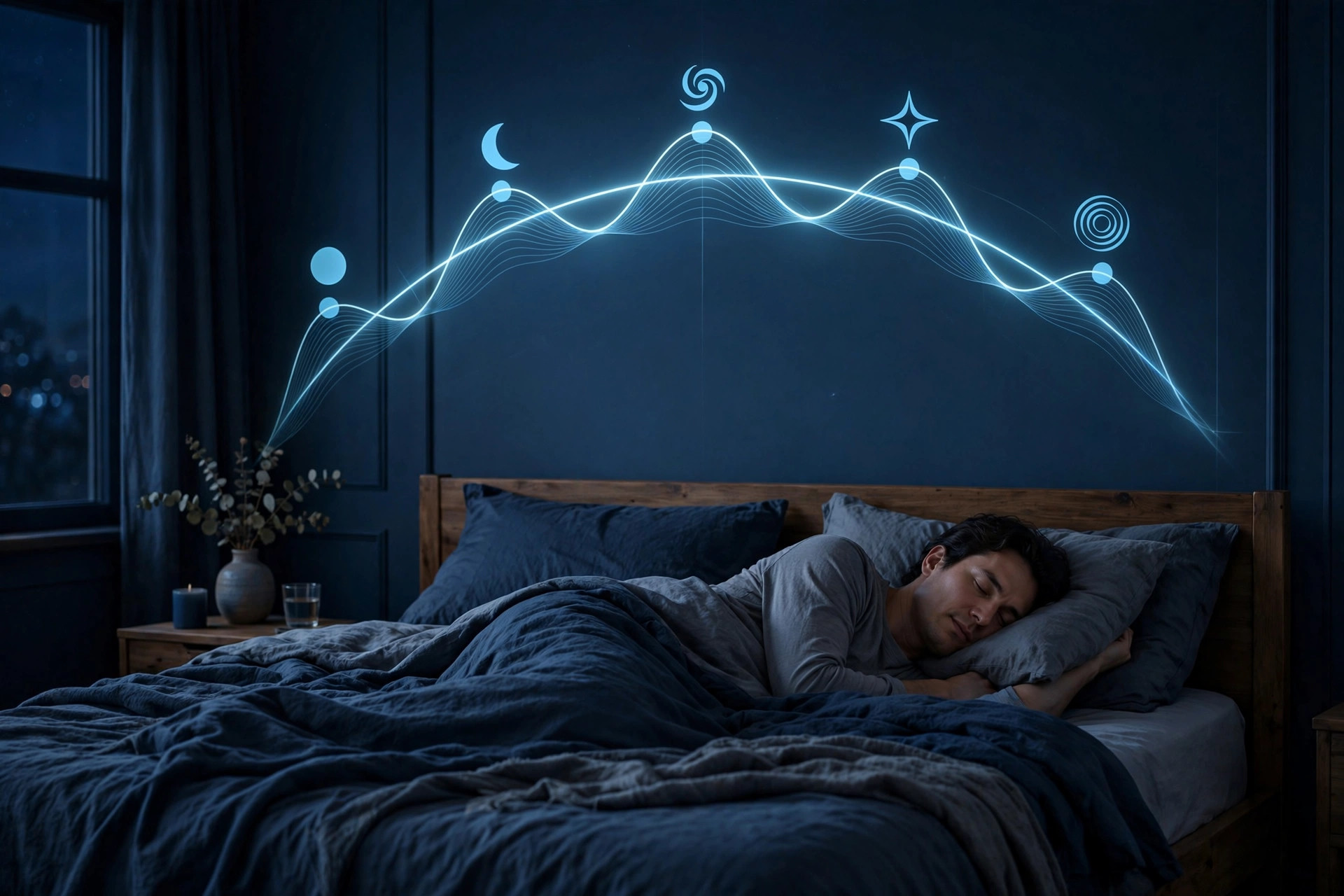
Here’s the framing only a sleep calculator site can give you honestly. Sleep runs in roughly 90-minute cycles — light sleep, deep slow-wave sleep, then REM, then back around. Your brain wakes most naturally in the gaps between cycles.
- 6 hours = about 4 complete cycles (4 × 90 min = 360 min)
- 7 hours = 4 cycles + 60 min into a 5th = 4.67 cycles — a mid-cycle wake
- 7.5 hours = exactly 5 complete cycles (5 × 90 min = 450 min)
- 9 hours = exactly 6 complete cycles (6 × 90 min = 540 min)
Real cycles vary between about 70 and 110 minutes, so these are averages — but the pattern holds. At 7 hours, your alarm fires roughly 40–60 minutes into cycle five, when you’re likely deep in slow-wave or REM sleep. Waking mid-cycle triggers sleep inertia: that heavy, groggy, cognitively underwater feeling that can take 30–60 minutes to clear.
This is the paradox so many people report: “I felt sharper on 6.5 hours than on 7.” They’re not wrong — they woke at a cycle boundary. It doesn’t mean 6.5 is healthier (it isn’t, long-term), but it explains why 7 hours feels oddly punishing.
The bottom line: on cycle math alone, 7.5 hours beats 7 hours almost every time — not because it’s 30 extra minutes, but because it lands the alarm between cycles instead of inside one.
7 vs 7.5 vs 8 Hours: What the Extra Time Actually Buys You
Not every hour of sleep is equal. Deep slow-wave sleep dominates the first half of the night, while REM sleep — the stage tied to memory consolidation, creativity, and emotional regulation — concentrates in the second half. The last two cycles of the night are REM-rich.
So when you cut your night from 8 hours to 7, you’re not losing an equal slice of every sleep stage. You’re disproportionately losing REM. That missing hour is where some of your most important overnight brain work happens: stitching memories together, processing the day’s emotions, and running the “overnight therapy” that keeps mood stable.
| Sleep length | Complete cycles | What you likely lose |
|---|---|---|
| 7 hours | 4 + a broken 5th | Mid-cycle wake; the REM-rich tail of the night gets clipped |
| 7.5 hours | 5 clean cycles | Wakes at a natural boundary; preserves the final REM episode |
| 8 hours | 5 cycles + part of a 6th | Full REM protection; a buffer for nights with fragmented sleep |
A widely cited 2018 study of more than 10,000 people found that cognitive performance — verbal skills, reasoning, and overall thinking ability — wasn’t at full capacity outside the seven-to-eight-hour range. Regularly getting less than that range measurably impaired performance. And a 2023 study found a 27% increased risk of infection in people getting less than six hours — the danger zone you flirt with when 7 hours in bed shrinks below 7 hours asleep.
The bottom line: going from 7 to 7.5 or 8 hours doesn’t just add time — it disproportionately protects REM, the stage most tied to how sharp and emotionally balanced you feel the next day.
7 Hours in Bed Is Not 7 Hours of Sleep
Here’s the arithmetic error almost everyone makes. The official guidelines say 7 hours of sleep — not 7 hours in bed. And healthy adults take 10 to 20 minutes to fall asleep after lights out (that’s sleep latency), according to the Sleep Foundation. Add a brief mid-night wake or two — normal for most adults — and the math gets uncomfortable:
- 7 hours in bed − 15 min falling asleep − 10 min of brief wakes = ~6 hours 35 minutes of actual sleep
That lands you squarely in the range the AASM flags as inadequate. To genuinely get 7 hours of sleep, you need roughly 7 hours 20 minutes in bed. To get 7.5 hours of real sleep, plan for nearly 7 hours 50 minutes in bed.
This is why sleep scientists talk about sleep efficiency — the percentage of time in bed actually spent asleep. Healthy sleepers hit about 85–90%. If you’re in bed for exactly 7 hours at 85% efficiency, you slept under 6 hours. That’s the danger zone for immune function, blood sugar, and next-day cognition.
The bottom line: when you set your bedtime, add 20 minutes to whatever sleep target you’re aiming for. Your “7 hours” was probably 6.5 — now you know why mornings felt rough.
Which Hour You Cut Matters More Than You Think
Two people both sleep 7 hours, but their sleep isn’t the same. It depends on which hour they skipped:
- Staying up an hour later (cutting the first hour) sacrifices disproportionate deep slow-wave sleep, which dominates early in the night. That’s the physically restorative stage — growth hormone release, tissue repair, immune strengthening. You wake feeling physically unrested, achy, or like you have a cold coming on.
- Waking an hour earlier (cutting the last hour) sacrifices disproportionate REM sleep, which concentrates late in the night. You wake feeling mentally foggy, emotionally fragile, and creatively flat — the classic “I slept fine but I’m a zombie” feeling.
Neither is good, but they break different things. This is also why shifting your whole sleep window earlier (earlier bedtime and earlier alarm) usually beats simply getting up earlier — it protects both ends of your sleep architecture.
The bottom line: if you’re trimming to 7 hours, protect your bedtime first. The deep sleep in the first half of the night is the hardest to recover.
Who Is 7 Hours of Sleep Actually Enough For?
Individual sleep need is real and varies more than most articles admit. Seven hours genuinely works for:
- People in their 50s and beyond. Sleep need declines modestly with age — the NSF recommends 7–8 hours for adults 65+, and Harvard Health notes older adults often do well on 7–8 hours.
- True short sleepers — an estimated 1–3% of people with rare gene variants (like DEC2) who function fully on 6 hours or less. They’re real, but vanishingly rare. If you need an alarm, caffeine, and weekends to survive, you’re not one of them.
- People who wake naturally before their alarm feeling refreshed and stay alert all day without stimulants. That’s the gold-standard test of sufficient sleep: if you consistently beat your alarm and feel good, your number might genuinely be 7.
The honest self-test isn’t how you feel at 9 a.m. — it’s whether you fade at 2 p.m., need caffeine to function, or sleep 10 hours on weekends. Weekend catch-up sleep is your body showing you the debt your weekday 7 hours created.
Who Needs More Than 7 Hours
For some groups, 7 hours falls below the evidence-based minimum:
- Teenagers (13–17): need 8–10 hours. Their circadian rhythm shifts later biologically, and 7 hours is genuine sleep deprivation — linked to worse grades, mood problems, and higher accident risk.
- Anyone repaying sleep debt: after weeks of short nights, your body will want extra sleep until the debt clears. The AASM notes 9+ hours can be appropriate during recovery.
- Athletes in heavy training: physical repair scales with deep sleep, and intense training increases total need.
- People who are ill, pregnant, or under major stress: immune activation and hormonal changes raise sleep need temporarily.
- Young adults (18–25): many still need closer to 8–9 hours, especially with irregular schedules.
This is educational context, not medical advice — if you consistently feel exhausted despite 7–8 hours, or you snore loudly, gasp, or stop breathing at night, talk to a healthcare professional. Those can be signs of a sleep disorder like sleep apnea, which no amount of bedtime math will fix.
Find Your Number: The 2-Week Sleep Experiment
Guidelines are population averages. Your number is personal — and you can find it in two weeks:
- Pick a fixed wake time and hold it for 14 days, weekends included. Consistency matters more than the exact hour.
- Go to bed 8 hours before your alarm for week one (that gives ~7.5 hours of actual sleep after latency).
- Rate each day 1–5 on: morning alertness (no snooze?), afternoon energy (the 2 p.m. test), and evening mood.
- Week two: shift bedtime 30 minutes earlier (8.5 hours in bed, ~8 hours asleep) and compare your scores.
- Read the results. If week two clearly wins, your number is closer to 8. If scores barely move, 7.5 is probably your number. If you start waking before the alarm during either week, you may have found it exactly.
The bottom line: two weeks of honest tracking beats a lifetime of guessing. Most people discover their number is 30–60 minutes higher than what they’d been getting — and the difference in how they feel is unmistakable.
How to Upgrade From 7 to 7.5 Hours Without Losing Your Evening
The jump from 7 to 7.5 hours sounds like giving up your evening — but it usually isn’t. Thirty minutes is one episode, one scroll session, one “just one more video.” Practical moves that actually work:
- Shift in 15-minute steps. Move bedtime 15 minutes earlier for 4–5 nights, then 15 more. Your circadian rhythm adapts far better to gradual shifts than sudden ones.
- Protect the wind-down. Screens off 30 minutes before bed isn’t moralizing — alerting content delays sleep onset, which is the exact time you’re trying to buy back.
- Anchor your mornings with light. Bright light within 30 minutes of waking locks in your circadian rhythm, making the earlier bedtime feel natural within a week.
- Do the cycle math once, then automate it. Pick your wake time, count back 5 cycles (7.5 hours) plus 15–20 minutes to fall asleep, and that’s your bedtime. Or skip the math — run your wake-up time through our free sleep calculator and it will hand you the exact bedtimes that land your alarm between cycles.
Related reading: if you’re curious about how many sleep cycles per night you actually need, or wondering whether 6 hours of sleep is enough, those guides dig deeper into the numbers behind this one.
Frequently Asked Questions
Is 7 hours of sleep enough for adults?
Yes — 7 hours meets the minimum recommended by the AASM, CDC, and National Sleep Foundation for adults 18–64. But it’s the floor, not the ideal. Most adults feel and perform better at 7.5–8 hours, which completes five full 90-minute sleep cycles instead of waking mid-cycle.
Is 7 hours of sleep enough for a teenager?
No. Teenagers aged 13–17 need 8–10 hours of sleep. Their circadian rhythms shift later during puberty, and 7 hours is genuine sleep deprivation for them — linked to poorer school performance, mood problems, and higher injury risk.
Is 7 hours or 8 hours of sleep better?
For most adults, 8 hours (or at least 7.5) is better. The extra time disproportionately protects REM sleep, which concentrates in the last cycles of the night and supports memory, creativity, and emotional regulation. Seven hours often means waking mid-cycle, which triggers grogginess (sleep inertia).
Why do I feel tired after 7 hours of sleep?
The most common reason is a mid-cycle wake: 7 hours equals about 4.67 ninety-minute cycles, so your alarm fires during deep or REM sleep. Also check your real sleep time — with 10–20 minutes of sleep latency, 7 hours in bed is often only ~6.5 hours of actual sleep.
Can I train myself to need only 7 hours of sleep?
Probably not. Sleep need is largely biological — true short sleepers (who thrive on 6 hours or less) are estimated at just 1–3% of people with rare gene variants. If you need an alarm, caffeine, and weekend catch-up to survive on 7 hours, your body is telling you it needs more.
Is 7.5 hours of sleep better than 7?
Yes, for most people. Five complete 90-minute cycles (7.5 hours) let your alarm land between cycles, avoiding the mid-cycle wake that causes sleep inertia at 7 hours. It’s the single highest-leverage 30-minute upgrade in sleep science.
The Bottom Line
Is 7 hours of sleep enough? It’s enough to stay on the safe side of the official guidelines — but for most adults, it’s the worst good number in the cycle system: enough to avoid the documented harms of short sleep, yet timed almost perfectly to wake you mid-cycle, groggy, with your REM-rich final hour clipped.
The upgrade costs just 30 minutes and changes everything: 7.5 hours completes five full cycles, protects the REM-heavy tail of your night, and lets you wake at a natural boundary instead of being dragged out of deep sleep. Find your personal number with the two-week experiment above — and when you’re ready to lock it in, use our free sleep calculator to find the exact bedtime that lands your alarm between cycles, every single night.
This article is educational content, not medical advice. If you consistently feel exhausted despite adequate sleep, or suspect a sleep disorder, please consult a healthcare professional.
Sources
- AASM & Sleep Research Society — Recommended Amount of Sleep for a Healthy Adult: A Joint Consensus Statement (SLEEP, 2015)
- Sleep Foundation — Is 7 Hours of Sleep Enough? and Sleep Latency
- Harvard Health Publishing — Ask the Doctor: The Right Amount of Sleep
- Healthline — Is 5 Hours Enough Sleep? (2018 Western University study of 10,000+ people; 2023 infection-risk study)