Best Sleeping Position: Side vs Back vs Stomach Compared
Quick test: how did you fall asleep last night? Now — how did you wake up this morning? If those answers are different, you’re completely normal. The average adult shifts position somewhere between 10 and 40 times a night, drifting between side, back, and occasionally stomach without ever fully waking.
So when sleep doctors get asked for the best sleeping position, the honest answer starts with a plot twist: you can’t hold one pose for eight hours, and you don’t need to. What you can control is where you start the night, where you spend most of it, and whether your pillow setup keeps your spine neutral while you’re there.
Here’s the verdict up front: for most adults, side sleeping edges out back sleeping, and both beat stomach sleeping by a wide margin. But “most” isn’t “you” — snorers, reflux sufferers, and back-pain patients each get a different winner. By the end of this guide, you’ll know exactly which camp you’re in, plus the two pillow tricks that make your chosen position actually work.
The Best Sleeping Position at a Glance
There is no single best sleeping position for everyone — sleep specialists at the Cleveland Clinic say so explicitly. But ranked by how they treat the average adult’s spine, airway, and joints, the three main positions fall into a clear order:
| Position | Best for | Think twice if you have | One-line pillow rule |
|---|---|---|---|
| Side | Most adults; snorers; night-time reflux (left side); pregnancy | Shoulder or hip pain on that side | Thick pillow filling the shoulder-to-neck gap + pillow between knees |
| Back | Neck and back pain; keeping the spine neutral; fewer facial wrinkles | Snoring, sleep apnea, reflux, late pregnancy | Medium pillow under head only + small pillow under knees |
| Stomach | People who can only fall asleep this way | Neck pain, back pain, arm numbness | Ultra-thin pillow (or none) + thin pillow under hips |
The bottom line: if you have no specific complaint and sleep fine, side sleeping is the safest default. If something bothers you — aches, snoring, heartburn — the sections below match your situation to the right pose.
Side Sleeping: Why the Majority Pick Wins
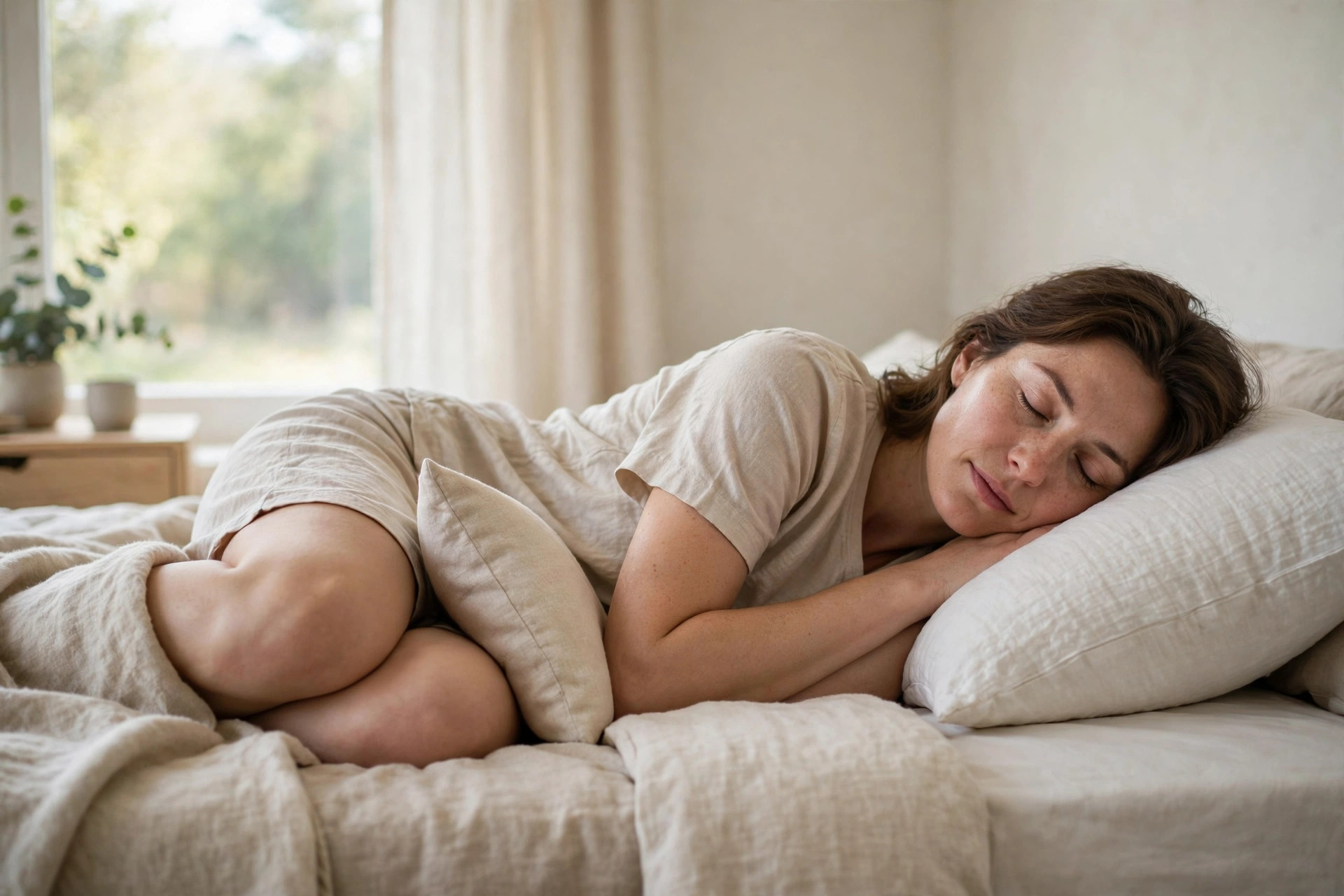
Roughly three in four adults sleep on their sides — it’s the most popular position in the world, and popularity here is a clue, not a coincidence. Side sleeping makes two things easier at once: keeping the spine straight and keeping the airway open.
When you lie on your side, gravity pulls your tongue and soft throat tissues forward instead of backward, so the airway stays wider. That’s why side sleeping is the first-line position advice for snorers and people with mild obstructive sleep apnea. Mayo Clinic sleep specialists go further: they call back sleeping the worst position for anyone with sleep apnea, because the tongue and jaw fall back and crowd the airway.
Side sleeping also keeps the spine in a neutral line — head stacked over shoulders, shoulders over hips — as long as your pillow fills the gap between your shoulder and your neck. Skip the knee pillow and your top leg drags your hips out of line all night, which is where a lot of mysterious morning hip and lower-back aches come from.
Left Side vs Right Side: Does It Actually Matter?
This is where competitors usually wave their hands. Here’s the honest breakdown:
| Factor | Left side | Right side |
|---|---|---|
| Acid reflux / GERD | Better — the stomach sits below the esophagus, so contents are less likely to flow upward | Worse — the stomach’s angle makes reflux more likely |
| Snoring & sleep apnea | Reduced vs. back sleeping | Reduced vs. back sleeping (about equal) |
| Pregnancy (2nd–3rd trimester) | Recommended — takes pressure off the inferior vena cava, improving blood flow | Acceptable early on; switch left later |
| Heart awareness | Some people feel their heartbeat and find it distracting | No heartbeat sensation for most |
The bottom line: left is the better default — especially if you deal with nighttime heartburn. But either side beats sleeping on your back for breathing, so don’t stress about rolling over.
The Fetal Position Trap
Side sleeping has one common failure mode: curling too tightly into a ball. A full fetal tuck rounds the upper back, compresses the chest, and can restrict breathing and stiffen joints. The fix is simple — keep your knees slightly bent and your body relaxed rather than cinched, like a runner at the starting line rather than a comma.
How to Set Up Side Sleeping Correctly
- Match pillow loft to your shoulder width. Your pillow should be thick enough that your ear lines up with your shoulder — your neck perfectly horizontal, not tilted up or sagging down.
- Add a pillow between your knees. This is the single highest-impact tweak for side sleepers. It stops the top leg from rotating your pelvis and pulling your lower spine out of alignment.
- Hug a body pillow if you roll. Wedging one in front of your chest discourages rolling onto your stomach; one behind your back blocks the roll onto your back.
- Keep your arms below your shoulders. Sleeping with arms jammed up under the pillow compresses nerves in the elbow and wrist — the classic cause of waking with a dead, tingling hand.
Back Sleeping: Great for Your Spine, Risky for Your Breathing
Back sleeping is often called the gold standard for spinal alignment, and the mechanics back that up. Your weight distributes evenly across the mattress, nothing is twisted or compressed on one side, and your cervical spine can rest in its natural curve. If you wake with neck or back pain and your pillow is wrong, back sleeping with proper support is frequently the fix.
But here’s the catch the mattress ads leave out: back sleeping is the worst position for breathing. Gravity pulls the tongue and soft palate straight back into the airway, which is why snoring gets louder on your back and why sleep physicians tell apnea patients to stay off it. It’s also the position most likely to aggravate nighttime reflux unless your upper body is slightly elevated.
The setup that makes it work: use a medium-loft pillow that fills the curve of your neck without pushing your chin toward your chest — the pillow belongs under your head and neck, not your shoulders. Slide a small pillow or rolled towel under your knees; this flattens the lumbar curve slightly and takes pressure off the lower back. And keep your arms at your sides or on your belly, not folded across your chest.
Who should skip it: habitual snorers, anyone diagnosed with sleep apnea, people with chronic nighttime reflux, and anyone in the second half of pregnancy (the uterus can compress major blood vessels when you’re flat on your back).
Stomach Sleeping: Why It Ranks Last (and the Damage-Control Plan)
Only about 7% of adults sleep on their stomachs, and sleep medicine wishes that number were lower. The problem is mechanical: to breathe face-down, you must turn your head roughly 90 degrees to one side and hold it there for hours. That sustained rotation strains the cervical spine, and the position also flattens the natural curve of the lower back, loading the lumbar discs.
Over years, all-night stomach sleeping is linked to chronic neck stiffness, lower-back ache, and nerve compression that shows up as morning numbness in the arms. Physicians at Keck Medicine of USC name it the worst of the three positions outright. The one genuine point in its favor — some people snore less on their stomachs — doesn’t come close to outweighing the spinal cost.
If you’re a committed stomach sleeper, damage control looks like this: use the thinnest pillow you can tolerate, or none at all, to minimize neck rotation. Tuck a slim pillow under your hips to support the lower back’s curve. And consider that you may not need a revolution — many stomach sleepers can transition to their side within a couple of weeks:
The 5-Step Stomach-to-Side Transition
- Hug a body pillow. It gives your arms and chest something to wrap around, replacing the “sprawled” feeling stomach sleepers miss.
- Start the night on your side — every night. You only need to fall asleep there; even if you roll later, you’re retraining the default.
- Block the roll. A firm pillow wedged behind your back makes rolling onto your stomach physically awkward without waking you.
- Drop the pillow loft gradually. Stomach sleepers use flat pillows; side sleeping needs loft. Add thickness over a week so your neck adapts.
- Give it 10–14 nights. Position habits are stubborn but shallow — most people report the side position feeling natural within two weeks.
The Part Nobody Tells You: You Won’t Stay Put Anyway
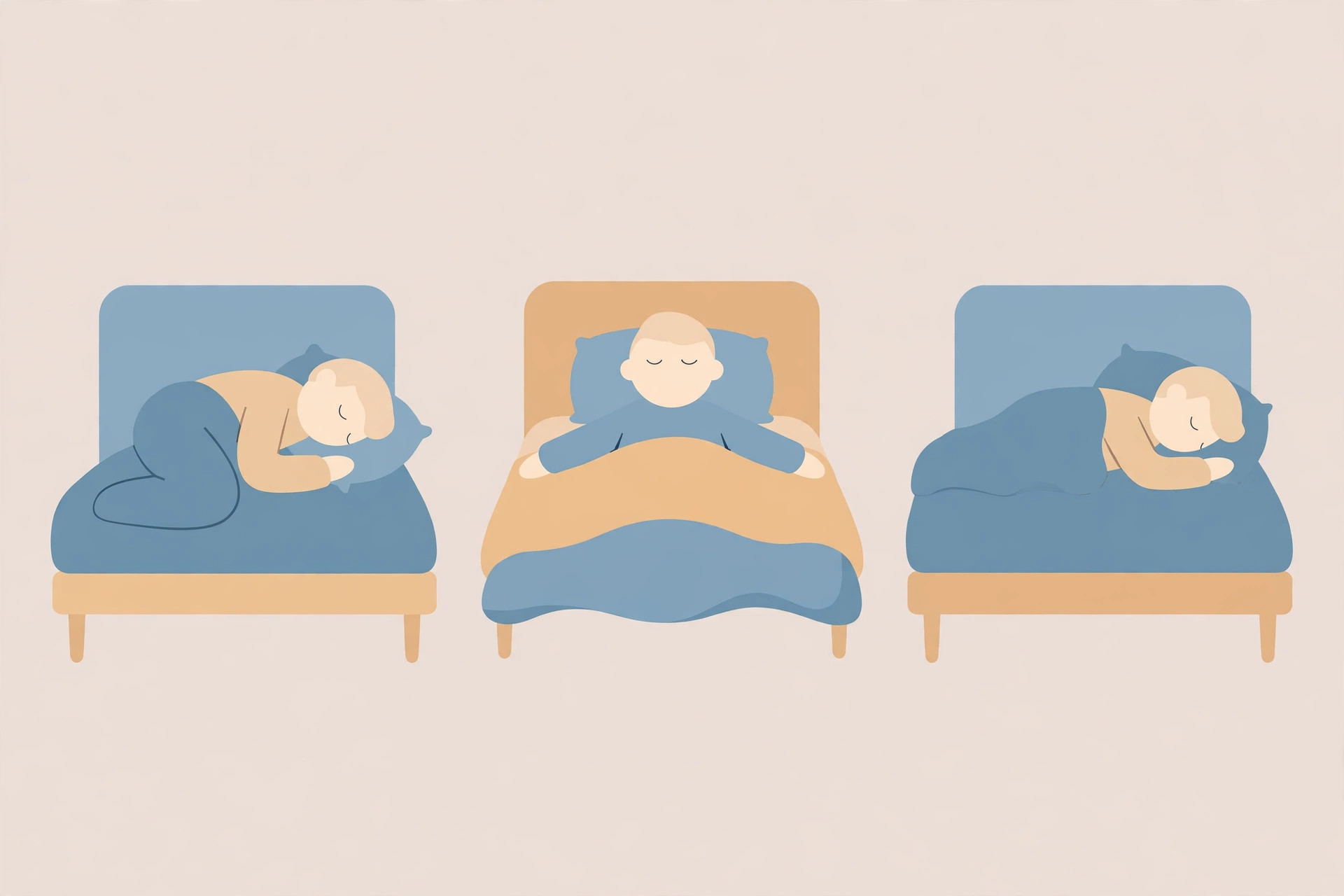
Here’s the liberating truth buried in the sleep research: holding one perfect position all night is neither possible nor necessary. Adults reposition dozens of times per night, mostly during the brief awakenings between 90-minute sleep cycles that you never remember. Deep slow-wave sleep is when you’re stillest; lighter stages are when you roam.
That reframes the whole question. You’re not choosing a position for eight hours — you’re choosing a starting position and a setup. The hours you spend in your starting pose, especially the first half of the night when deep sleep dominates, are the hours that count most.
So the practical strategy is: fall asleep in your best position, and make the alternatives slightly inconvenient. Body pillows, wedges, and the old sewn-pocket trick (a soft ball in a pocket stitched to the back of a T-shirt makes back-rolling uncomfortable) all work on the same principle — not restraint, but gentle discouragement. If you wake up somewhere else, that’s fine. Your body moved because it wanted to, and comfort is still the ultimate goal.
The Brain Angle: Does Side Sleeping Help Your Brain Clean Itself?
Here’s the most fascinating — and most overstated — claim in this debate. During deep sleep, the brain runs its waste-clearance system, the glymphatic system: cerebrospinal fluid washes through brain tissue, flushing out metabolic debris including amyloid-beta and tau, the proteins implicated in Alzheimer’s disease.
In 2015, researchers at Stony Brook University published a striking finding in the Journal of Neuroscience: in anesthetized rodents, glymphatic transport was significantly more efficient in the lateral (side) position than on the back or stomach. The team proposed that side sleeping may have evolved as the default mammalian posture precisely because it optimizes overnight brain cleaning.
The honest caveat: that was an animal study under anesthesia, not natural human sleep — and the lead researchers themselves said human imaging studies are needed before drawing conclusions about people. The effect is real in rodents and biologically plausible in humans, but it is not proven in humans. Treat it as one more intriguing point for side sleeping, not a reason to panic if you’re a happy back sleeper. This is educational content, not medical advice — if a sleep position is causing you pain or breathing problems, that’s a conversation for your doctor, not a blog post.
The 7-Night Plan to Lock In a Better Position
Don’t overhaul everything on night one. Small, sequential changes stick; big ones get abandoned by Wednesday.
- Nights 1–2: Observe. Change nothing. Notice where you fall asleep and where you wake up. Most people are surprised.
- Nights 3–4: Fix the pillow. Adjust loft for your target position only — thick for side, medium for back, flat for stomach. Morning neck comfort is the scoreboard.
- Nights 5–6: Add one support. Knee pillow for side sleepers, under-knee pillow for back sleepers, body pillow for transitioning stomach sleepers. One variable at a time.
- Night 7: Audit. Do you fall asleep faster? Wake up less stiff? If yes, lock in the setup. If no, change exactly one thing and run another week.
Pillow-Loft Cheat Sheet
Wrong pillow height ruins good positions — around a third of side sleepers report neck pain, and pillow loft is the usual culprit. Use this as your buying guide:
| Position | Pillow height (loft) | Extra support |
|---|---|---|
| Side | Medium-high (4–6 inches) — must fill the shoulder-to-neck gap | Firm pillow between knees; optional body pillow |
| Back | Medium (3–5 inches) with neck contour — chin neutral, not tilted | Small pillow or rolled towel under knees |
| Stomach | Very low (under 3 inches) or none | Slim pillow under hips to support the lower back |
Which Sleeping Position Is Right for You?
- You snore or have mild sleep apnea → side sleeping, every time. It’s the single most effective positional change.
- You wake with neck or back pain → back sleeping with proper support, or side sleeping with the knee-pillow setup.
- Nighttime heartburn wakes you up → left-side sleeping, possibly with the head of the bed slightly raised.
- You’re pregnant (2nd–3rd trimester) → left side, with a pillow between the knees (we’ll cover pregnancy sleep in full detail in an upcoming guide).
- Your shoulder aches on one side → back sleeping, or the pain-free side.
- You sleep fine and wake up fine → change nothing. The Cleveland Clinic’s advice is blunt: if your position isn’t causing problems, it isn’t a problem.
The Bottom Line
The best sleeping position isn’t a pose — it’s a match between your body and your setup. Side sleeping wins the most matchups: it’s the easiest on the airway, kind to the spine when supported, and the default for roughly three-quarters of adults. Back sleeping is the alignment purist’s choice with a real breathing trade-off. Stomach sleeping is the one position worth actively leaving, and the transition is easier than its devotees expect.
But position is only half the equation — timing is the other half. Even the perfect posture won’t save a morning if your alarm drags you out of deep sleep mid-cycle. Once you’ve picked your position, plan your ideal bedtime with our free sleep time calculator so you wake at the light end of a sleep cycle instead — refreshed, in whatever position you landed in. And if you regularly wake up tired after a full night’s sleep, your position might be only part of the story; sleep quality often matters more than the hours you log.
Sources
- Mayo Clinic News Network — “What is the best sleeping position?” (newsnetwork.mayoclinic.org)
- Cleveland Clinic — “Does Your Sleeping Position Really Matter?” (newsroom.clevelandclinic.org)
- Lee, H. et al. (2015). “The Effect of Body Posture on Brain Glymphatic Transport.” Journal of Neuroscience, 35(31), 11034–11044. (jneurosci.org)
What is the healthiest sleeping position?
For most adults, side sleeping is the healthiest default: it keeps the airway open (reducing snoring and mild sleep apnea), supports neutral spinal alignment with the right pillow setup, and is the recommended position during pregnancy. Back sleeping is equally good for spinal alignment but worse for breathing. Stomach sleeping ranks last because it twists the neck and strains the lower back.
Is it bad to sleep on your stomach every night?
Yes — stomach sleeping puts the most strain on the neck and lower back of any position, since your head must stay turned to one side for hours. Over time this contributes to neck stiffness, back ache, and arm numbness. If you can’t fall asleep any other way, use a very thin pillow (or none) and transition gradually to side sleeping with a body pillow, which most people manage within two weeks.
Is sleeping on your left side better than your right?
Slightly. Left-side sleeping is better for acid reflux (the stomach sits below the esophagus in that orientation) and is the recommended side in later pregnancy because it takes pressure off the inferior vena cava. Both sides are equally good for snoring and sleep apnea, and either side beats sleeping on your back for breathing.
How can I train myself to sleep on my side?
Start every night on your side — you only need to fall asleep there. Hug a body pillow to replace the sprawled feeling, wedge a firm pillow behind your back to block rolling, and make sure your pillow is thick enough to keep your neck level. Most people find side sleeping feels natural within 10–14 nights.
What kind of pillow is best for side sleepers?
A medium-high loft pillow (about 4–6 inches) that’s thick enough to fill the gap between your shoulder and neck so your spine stays straight. Add a firm pillow between your knees to keep your hips aligned — this one tweak resolves a large share of morning hip and lower-back aches in side sleepers.
Can your sleeping position cause neck pain?
Yes — and the pillow is usually guiltier than the position itself. A pillow that’s too high or too flat forces the neck out of its natural curve all night, and around a third of side sleepers report neck pain linked to pillow height. Match your pillow loft to your position (thick for side, medium for back, flat for stomach) before blaming the pose.